
GuideDayatas Profab · Insights
Is recycled ABS good enough for monitor housings and electronics casings?
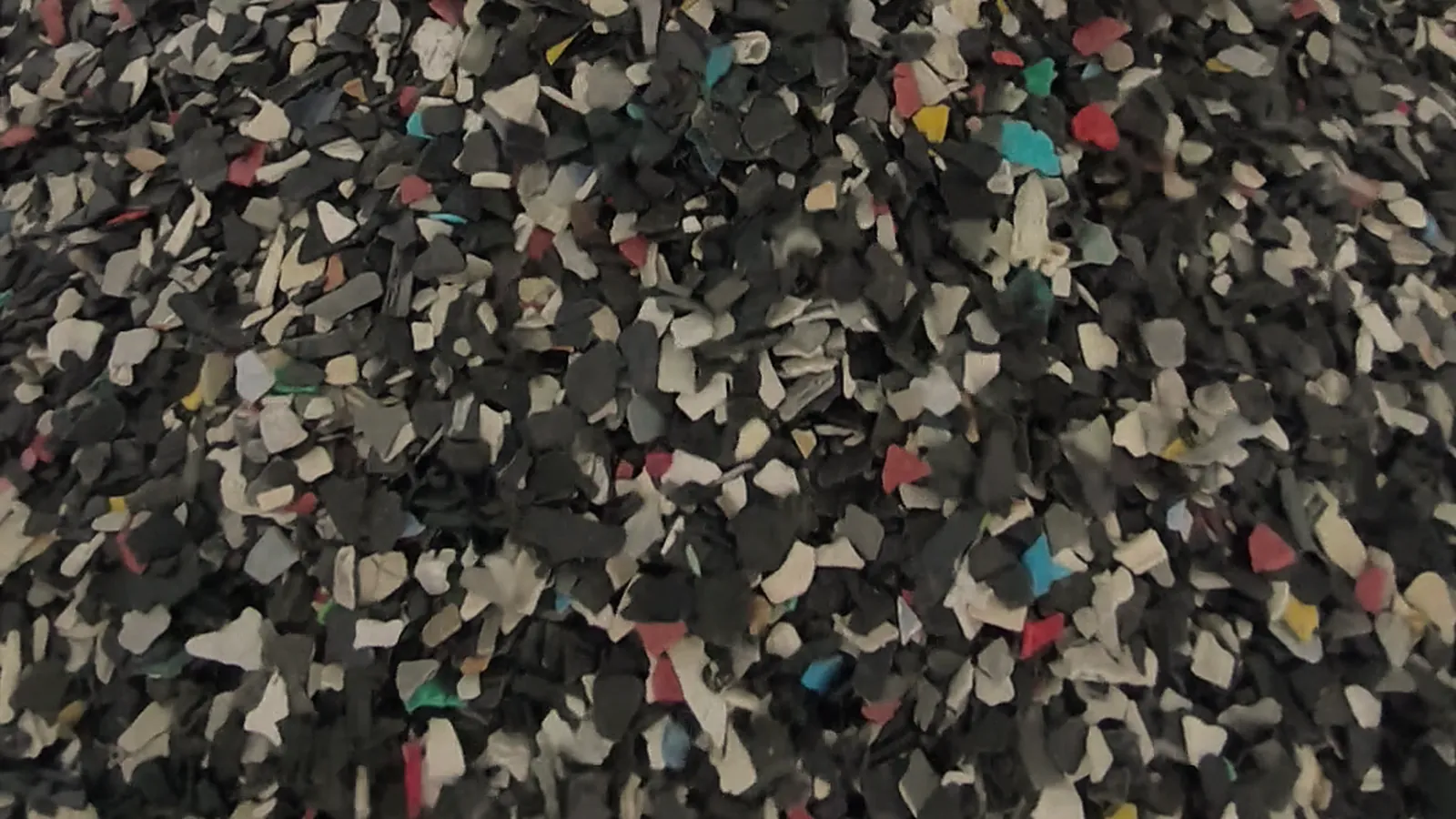
Often, yes. HP says 85.5% of the material in its E45c monitor's enclosure is recycled ABS from IT equipment. Recycled ABS suits a housing when the grade and each lot pass the checks: impact strength, heat resistance, colour, a UL 94 flame class where needed, leftover flame retardants and lot-to-lot consistency.
On this page10
✓Key takeaways
- Recycled ABS can be certified. Under UL 746S, first published in 2023, UL can give a mechanically recycled plastic the same ratings as a virgin resin in the same product category (source 9).
- Dayatas Profab's ABS is recycled pellet made in Malaysia, in 25 kg bags, and monitor housings are among the parts moulders make with its resin (see what moulders make with ABS, PS and HIPS).
- The scrap's original grade matters most. In Teixeira et al. (2023), e-waste ABS had about half the Izod impact strength of the virgin ABS tested, a gap the authors put down to grade, and six more reprocessing cycles left it at 55.5 J/m against 55.9 J/m at the start (source 7).
- Colour is the practical limit. LG Chem notes that recycling leaves mostly black or grey post-consumer recycled (PCR) ABS (source 4).
- Leftover flame retardants are the compliance risk. Jandric et al. (2020) found bromine in 33% of 1,008 plastic samples from discarded devices, and the EU bars every halogenated flame retardant from display enclosures (sources 8, 13).
Can recycled ABS be used for monitor housings and electronics casings?
Yes. Recycled ABS is already moulded into monitor enclosures and phone handsets, and UL can certify a recycled compound with the same ratings as a virgin resin. What a recycled grade cannot skip is qualification: recycled ABS earns its place on a housing through tests on its own lots, not through the reputation of virgin ABS. Internal parts are the easier first step, and a cosmetic outer shell asks the most.
HP's E45c monitor is the clearest example: Plastics Engineering reported in 2023 that 85.5% of the material in its enclosure is recycled ABS from information technology equipment (source 1). In a 2019 case study, Ford and Fisher found that 100% recycled ABS “has similar properties to virgin ABS” and can replace it “as long as the product design allows for the slightly stiffer nature of the rABS and addresses issues of surface finish and ability to colour”; designed that way, their phone handset was “as robust and as cosmetically acceptable as one made of virgin ABS” (source 2).
Recycled ABS can also be safety-certified: under UL 746S, first published on 30 August 2023, UL can assign a mechanically recycled plastic the same ratings as a virgin resin within the same product category (source 9). Plastics Engineering names internal covers, brackets, spacers and non-cosmetic components as lower-risk applications, and says exterior shells, screw bosses, latch regions and heat-adjacent areas “require control of melt flow” and of the polymer's composition, additives and thermal history. It also lists PC and PC/ABS among housing polymers (source 3).
What does a monitor housing ask of recycled ABS, and how do you check it?
A monitor housing or electronics casing asks recycled ABS for seven things: impact strength at its screw bosses and latches, a steady melt flow for thin walls, heat resistance near the electronics, the right colour and finish, a flame class where the product needs one, no restricted flame retardants, and the same results lot after lot. Each has a check a supplier can be asked for.
| What the housing needs | What to ask for | Standard or reference |
|---|---|---|
| Impact strength at bosses, latches and corners | Izod impact strength for the lot, plus impact tests on moulded housings | ISO 180 or ASTM D256 (sources 20, 21) |
| Steady flow into thin walls and ribs | Melt flow (MFR or MVR) for every lot | ISO 1133-1 or ASTM D1238 (sources 22, 23) |
| Heat resistance near the electronics | The grade's heat deflection temperature | ISO 75-2 or ASTM D648 (sources 24, 25) |
| Colour and finish | A sample moulded on your own tool, approved against a reference part | Your approved part |
| A flame class, where the product needs one | The recycled grade's own UL 94 rating at your wall thickness | UL 94; UL 746S for recycled compounds (sources 10, 9) |
| No restricted flame retardants | A bromine screen; PBB and PBDE where bromine shows; for an EU display, which flame retardant the grade contains | IEC 62321-3-1, IEC 62321-6; RoHS; Regulation (EU) 2019/2021 (sources 18, 19, 11, 13) |
| The same results lot after lot | The same tests on every lot, against the values of the approved lot | Ongoing tests, as in UL 746S (source 9) |
Each check is made on the lot you will receive, because electronics waste streams “rarely arrive as clean single-polymer feedstocks”, as Plastics Engineering puts it (source 3). The values a recycled datasheet should carry are covered in what a recycled resin datasheet should show, and when virgin ABS is still the safer choice in recycled vs virgin ABS. To ask Dayatas Profab about recycled ABS for a housing, send the part, wall thickness, colour, flame class and market through the buyer enquiry form.
How much impact strength does recycled ABS lose?
In one detailed study, the original grade of the scrap mattered more than the recycling. In Teixeira et al. (2023), ABS from e-waste tablet casings started at about half the Izod impact strength of the virgin ABS tested, 55.9 against 114.6 J/m, which the authors attribute to the two being different grades. Six further reprocessing cycles left the e-waste ABS at 55.5 J/m (source 7).
The e-waste ABS in that study dipped to 52.1 J/m at the second cycle before recovering, its tensile properties held over six cycles, and its melt flow index rose 15% from the first to the sixth extrusion (source 7), so a recycled lot can fill a thin wall differently from the grade the tool was set up on. The study used one source of scrap, tablet casings.
Where impact strength falls short, blending is the usual fix: the EU-funded PLAST2bCLEANED project's recovered ABS met the requirements for washing-machine door frames, “although the impact strength required blending with virgin materials” (source 6). Judge any grade on moulded parts, because housing impact failures start at local features such as corners, weld lines, screw bosses and latches, and “standard coupon data may not capture these localized failure modes” (source 3). Drying and press settings for ABS are in ABS, PS or HIPS: which resin for an injection-moulded part.
Can recycled ABS match the colour and finish of a monitor housing?
For a white or light housing, recycled ABS needs a grade made from colour-sorted scrap or a painted finish. LG Chem notes that recycling blends many colours and leaves mostly black or grey post-consumer recycled ABS, which has limited its use in products with high whiteness (source 4).
A white recycled grade, LG Chem explains, “requires sorting and selecting of waste plastics with bright colors before they get crushed into pellets” (source 4). The picture at the top of this page, from Dayatas Profab's own production footage, shows crushed plastic flakes of several colours. How sorting, washing and extrusion turn flakes into pellets is explained in how plastic scrap is turned into resin pellets.
ABS can also be painted (source 26). For an unpainted housing, approve colour and gloss on a part moulded on your own tool, beside a reference part, rather than on a pellet sample.
Does a recycled ABS housing need its own UL 94 rating?
Yes, whenever the product calls for a flame class: the rating has to belong to the recycled grade itself, at your wall thickness, not to the virgin ABS it replaces. UL calculates a UL 94 rating taking account of the material thickness, and under UL 746S it can give a mechanically recycled compound the same ratings as a virgin resin in the same product category (sources 10, 9).
Flame-rated recycled ABS exists: LG Chem lists LETZero ABS MRC365L5, a flame-retardant ABS with 50% post-consumer recycled resin, at UL 94 V-0 at 2.0 mm, though still at an early stage of development (source 5). For an EU display, also ask which flame retardant a rated grade uses (see the next section). The rating has to hold for every lot: UL's recycled-plastics scheme lists “Impact plus UL 94 flammability” among its tests, to be repeated “on an ongoing basis as deemed required by the quality management system” (source 9).
What HB, V-2, V-1 and V-0 mean for a monitor housing is on quality and documents. Dayatas Profab has not yet published a UL 94 rating for its ABS; if your housing needs one, name the class and the wall thickness in your enquiry.
Why do flame retardants matter in recycled ABS from e-waste?
Because old electronics can still contain restricted flame retardants. The European Commission notes that some restricted halogenated compounds “may be still found in old displays”. Jandric et al. (2020) tested 1,008 plastic samples from 467 discarded devices and found bromine in 33% of them, with the RoHS limit exceeded in 10% of samples from PC housings and 9% from flat-screen monitors (sources 14, 8).
Three EU rules bear on recycled ABS for electronics:
- RoHS. Polybrominated biphenyls (PBB) and polybrominated diphenyl ethers (PBDE) may not exceed 0.1% by weight in any homogeneous material of electrical and electronic equipment (source 11).
- WEEE. Plastic containing brominated flame retardants has to be removed from separately collected e-waste (source 12).
- Ecodesign for displays. Since 1 March 2021, “the use of halogenated flame retardants is not allowed in the enclosure and stand of electronic displays” (sources 13, 17). A halogenated flame retardant is any flame retardant that contains a halogen (source 16), and the rule covers televisions, monitors and digital signage with screens over 100 cm² (source 15). Plastic parts heavier than 50 g must also be marked with their polymer type (source 13).
“Presence of halogenated flame retardants represents a major issue in the recycling of plastics of electronic displays.”
European Commission, Regulation (EU) 2019/2021, recital 15 (source 14)
The check runs in two steps. X-ray fluorescence screening to IEC 62321-3-1 measures total bromine (source 18); where bromine shows, PBB and PBDE are measured to IEC 62321-6 by gas chromatography and mass spectrometry (source 19). A PBB and PBDE pass does not settle the EU display rule, which bars every halogenated flame retardant from the enclosure, so for a monitor housing sold in the EU a lot that screens positive for bromine needs an explanation before it is used.
How do you keep every lot of recycled ABS like the one you approved?
Approve one lot of recycled ABS on your own tool, record its test values, then test every later lot against them. UL's scheme for recycled plastics works the same way, repeating impact and flammability tests on an ongoing basis under the quality management system. Judge the moulded housing rather than the recycled-content claim, because the scrap behind each recycled lot can change.
“For these applications, qualification should rely on molded-part performance rather than declared recycled content alone.”
Maria Vargas, Plastics Engineering, 6 August 2026, on exterior shells, screw bosses, latches and heat-adjacent parts (source 3)
- Describe the housing: part, wall thickness, colour, flame class and market.
- Approve a sample lot on your own tool, testing bosses, latches and corners and matching colour and gloss to a reference part.
- Record the approved values: melt flow, Izod impact strength, heat deflection temperature and the bromine screen.
- Compare every later lot's test report with those values before it goes to the press, and approve again when the scrap source or the process changes.
How to read lot-to-lot figures on a recycled datasheet is covered in what a recycled resin datasheet should show.
What can Dayatas Profab tell you about its recycled ABS today?
Dayatas Profab's ABS is recycled pellet, made in Malaysia and packed in 25 kg bags printed “ABS RECYCLED PELLET”, and monitor housings are among the products moulders make with its resin. Its production film is ready; spec sheets and test reports are to come; certification and licences are to come. Its datasheet values, flame rating and RoHS results are therefore not published yet.
The production film follows the ABS from plastic scrap to pellets bagged from a silo, on how it's made, and the resin is described on recycled ABS resin from Dayatas Profab. For a housing, tell us the part, wall thickness, colour, flame class, market, quantity and destination port. Monitor housings, motorbike covers and other moulded parts are compared on the parts moulders make with our resins. To ask about recycled ABS for a housing, use the buyer enquiry form.
Common questions about recycled ABS for electronics housings
Is recycled ABS RoHS compliant?
Not automatically. RoHS caps PBB and PBDE at 0.1% by weight in each homogeneous material, and plastic from old electronics can carry them, so the flame-retardant part is checked lot by lot: a bromine screen to IEC 62321-3-1, then a PBB and PBDE test to IEC 62321-6 where bromine shows. (sources 11, 18, 19)
Can recycled ABS be white?
Yes, but white is the hard colour. A white recycled grade has to be made from colour-sorted, brightly coloured scrap. Approve a white housing on a part moulded on your own tool. (source 4)
Is recycled ABS weaker than virgin ABS?
Not necessarily. Ford and Fisher (2019) found 100% recycled ABS similar to virgin ABS, though slightly stiffer. Some recycled ABS needs blending with virgin resin to reach the impact strength a part requires, so compare each lot's Izod impact strength with your current grade. (sources 2, 6, 20)
Can a monitor housing sold in the EU contain brominated flame retardants?
No. Since 1 March 2021, EU Ecodesign Regulation 2019/2021 has not allowed halogenated flame retardants, meaning any flame retardant that contains a halogen such as bromine, in the enclosure and stand of an electronic display. Displays with a screen of 100 cm² or less are outside the regulation. (sources 13, 16, 15)
Sources
Every external figure and quotation on this page was checked against its source on 25 October 2026. EU laws link to their text as adopted, with the official EU version on EUR-Lex.
- Plastics Engineering (SPE), Robert Grace, “HP Leverages Recycled Materials in Latest Computer Monitor”, 29 August 2023: the HP E45c monitor enclosure: 85.5% recycled ABS from information technology equipment
- Ford and Fisher, “Designing consumer electronic products for the circular economy using recycled ABS: a case study”, Journal of Cleaner Production 236, 2019 (Nottingham Trent University repository): 100% recycled ABS against virgin ABS; a recycled ABS phone handset
- Plastics Engineering (SPE), Maria Vargas, “Recycled Plastics in Electronics Housings Face Heat and Compliance Limits”, 6 August 2026: housing polymers; mixed e-waste feedstock; where impact failures start; lower- and higher-risk parts
- LG Chem, on its post-consumer recycled (PCR) ABS, 20 June 2023: where PCR ABS comes from; mostly black or grey pellets; making a white grade
- UL Prospector: LG Chem LETZero ABS MRC365L5 (flame-retardant PCR ABS): 50% PCR resin; UL 94 V-0 at 2.0 mm; designed for light colours; early stage of development
- CORDIS (European Commission), PLAST2bCLEANED: a novel process to recover clean polymers from hazardous e-waste: recovered ABS for washing-machine door frames; impact strength needed blending with virgin material
- Teixeira, Peres and Pacheco, “Mechanical recycling of ABS and HIPS from waste electrical and electronic equipment”, Frontiers in Sustainability, 2023: Izod impact, tensile properties and melt flow of e-waste and virgin ABS over six reprocessing cycles
- Jandric et al., bromine in WEEE plastics by X-ray fluorescence, Österreichische Wasser- und Abfallwirtschaft 72, 2020, doi:10.1007/s00506-019-00639-7 (abstract, US EPA HERO): 1,008 samples from 467 devices; bromine found; RoHS exceedances by device type
- UL Solutions: Recycled plastics testing and certification (UL 746S): UL 746S, first edition 30 August 2023; same ratings as virgin resin in the same product category; ongoing tests
- UL Solutions: combustion (fire) tests for plastics, UL 94: the UL 94 classes for enclosure materials; the rating takes account of thickness
- RoHS Directive 2011/65/EU, Annex II as replaced by Delegated Directive (EU) 2015/863, text as adopted: maximum concentrations by weight in homogeneous materials (official EU text: EUR-Lex)
- WEEE Directive 2012/19/EU, Annex VII, text as adopted: plastic containing brominated flame retardants removed from separately collected WEEE (official EU text: EUR-Lex)
- Commission Regulation (EU) 2019/2021, ecodesign requirements for electronic displays, Annex II, text as adopted: no halogenated flame retardants in the enclosure and stand; marking of plastic parts over 50 g (official EU text: EUR-Lex)
- Commission Regulation (EU) 2019/2021, recitals, text as adopted: recital 15, halogenated flame retardants and the recycling of display plastics
- Commission Regulation (EU) 2019/2021, Article 1, scope, text as adopted: televisions, monitors and digital signage; displays of 100 cm² or less excluded
- Commission Regulation (EU) 2019/2021, Annex I, definitions, text as adopted: definition of a halogenated flame retardant
- TÜV Rheinland: EU ecodesign requirements for electronic displays (current summary): the halogenated flame retardant requirement, effective 1 March 2021
- IEC 62321-3-1:2026, screening by X-ray fluorescence spectrometry: screening for total bromine and other elements
- IEC 62321-6:2015, PBBs and PBDEs in polymers by GC-MS: measuring PBB and PBDE
- ISO 180, Izod impact strength of plastics: impact strength
- ASTM D256, Izod pendulum impact resistance of plastics: impact strength
- ISO 1133-1, melt mass-flow rate (MFR) and melt volume-flow rate (MVR): melt flow
- ASTM D1238, melt flow rates of thermoplastics: melt flow
- ISO 75-2, temperature of deflection under load: heat deflection temperature
- ASTM D648, deflection temperature of plastics under flexural load: heat deflection temperature
- Wikipedia: Acrylonitrile butadiene styrene: painting and finishing ABS
Two doors into Dayatas Profab A · buyers of resin B · suppliers of scrap