
02Resin 02 of 03 · Polystyrene
PS resin for injection moulding.
+Where general-purpose PS suits
- Cases, boxes and traysRigid, low-impact items
- Parts where easy processing countsPolystyrene is easy to process
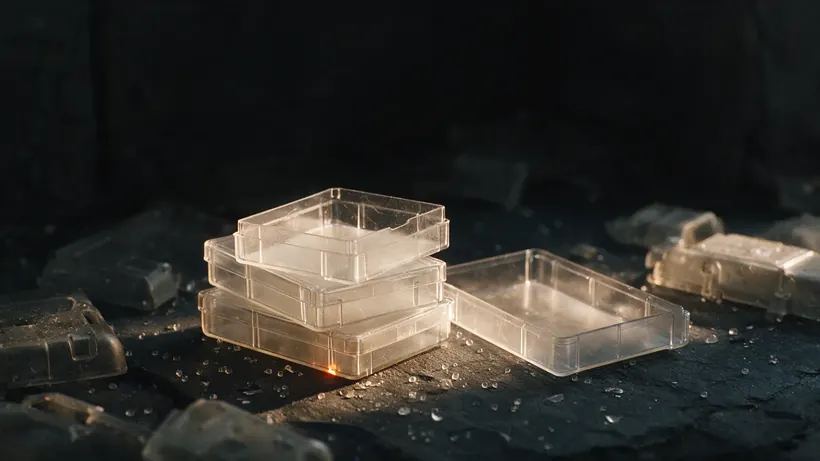
- See-through partsGeneral-purpose PS is transparent; ask if a grade is clear
↑Where to step up
General properties of polystyrene, not Dayatas Profab's figures (sources 1 to 3).
→PS at a glance
- Process
- Injection moulding
- Company's buyers
- All around the world
- Range
- Sold with HIPS and ABS
Last updated
Dayatas Profab Sdn Bhd sells PS resin for injection moulding, and the company's buyers are all around the world, including China and India. PS is polystyrene: in its general-purpose form, as a material, it is hard, rigid and easy to process, but brittle, so it suits rigid parts that do not need to take impact. Dayatas Profab's PS datasheet and test reports are to come.
On this page5
PS is polystyrene, a thermoplastic resin made by polymerising styrene, a single monomer. It comes in two basic types: general-purpose PS, also called crystal PS or GPPS, and high impact PS, or HIPS. General-purpose PS is a transparent polymer suited to injection moulding or extrusion; it is hard and rigid, and it is brittle.
Polystyrene is valued for its easy processing, and that, with its stiffness, is what a moulder buys it for. The price is brittleness: a sharp knock can crack a PS wall where a tougher resin would give. Dayatas Profab sells PS resin for injection moulding as the plain member of its styrenic range, beside HIPS, which adds a rubber phase, and ABS, which adds acrylonitrile and rubber. The drawing shows what each one adds.
- Polystyrene chainsOne monomer, styrene: hard, rigid and easy to process, but brittle
- Rubber particles (HIPS, ABS)Polybutadiene; they improve impact strength
- Acrylonitrile units (ABS)Hardness, rigidity and chemical resistance
General-purpose PS falls short where a part must survive drops, impacts or repeated flexing, because it is brittle. Parts handled every day and covers on equipment that moves are better moulded in a tougher resin.
HIPS resin keeps the polystyrene base and adds a dispersed rubber phase that improves impact strength; step up to it when a part will be knocked but does not need a glossy, scratch-resistant face, as in many appliance parts. Step up to ABS resin when strength, scratch resistance and finish all matter. Dayatas Profab sells all three resins, so one enquiry can weigh PS against HIPS and ABS for the same part. The side-by-side comparison is on ABS vs PS vs HIPS, and the parts each resin goes into are on what moulders make with ABS, PS and HIPS.
- PSPolystyreneThe base: one monomer, styrene. Hard, rigid and easy to process, but brittle.This page
- HIPSHigh impact polystyreneA dispersed rubber phase added to polystyrene, which improves impact strength.HIPS resin
- ABSAcrylonitrile butadiene styreneAcrylonitrile and butadiene rubber added: hardness, rigidity, chemical resistance and toughness.ABS resin
SC.03
What is confirmed so far for Dayatas Profab's PS?
Dayatas Profab sells PS resin for injection moulding; that much is confirmed. The register on this page sets out, once, what is still open for its PS and how each open point will be closed.
Whether Dayatas Profab's PS is recycled or virgin matters to a moulder, because the two are judged differently; recycled vs virgin resin explains how. Until the details are confirmed, ask us about the part you mould and we will tell you what we know.
→The register for PS
Confirmed
- Resin
- PS, polystyrene
- Process
- Injection moulding
- Company's buyers
- All around the world, incl. China and India
Being confirmed
- Recycled or virgin
- Which of the two
- Form and packing
- Pellet or other form; bag size
- Colour
- Including whether it is clear
Documents
- Datasheet, test reports
- To come
- Certification
- To come
Three values to ask for
For any PS lot, ask for three datasheet values and the test method behind each. The melt flow rate (ISO 1133-1 or ASTM D1238) shows how easily the melt flows. The Izod impact strength (ISO 180) shows how much energy the material absorbs before it breaks, and on a brittle resin it is the number to watch. The density (ISO 1183-1) sets part weight and shot size. Ask, too, for a test report for the lot you are buying, not only a typical sheet.
Where Dayatas Profab's PS documents stand
Dayatas Profab's PS datasheet, test reports and certification are to come; each will be posted on quality and documents when it is issued. The production film that buyers in Europe and America often ask to see is on how Dayatas Profab's resin is made. The table below is general guidance on what to look for on any PS datasheet, from any supplier.
Datasheet guide · PS
What to look for on any PS datasheet
| Property | Test method | What it tells you | Reported in |
|---|---|---|---|
| Melt flow rate | ISO 1133-1 · ASTM D1238 | How easily the melt flows | g / 10 min |
| Izod impact strength | ISO 180 | How much energy the material absorbs before it breaks | kJ/m² |
| Density | ISO 1183-1 | Part weight and shot size | g/cm³ |
SC.05
How do you order PS resin from Dayatas Profab?
Because the details of its PS are still open, the most useful enquiry says what the part needs: how stiff it must be, whether it must be see-through, and whether it will ever be knocked. Add the quantity, the destination port and the documents you need. The button on this card opens the buyer's form with PS ticked.
Prices, minimum orders and lead times are not listed on this site; ask about them in your enquiry. Dayatas Profab is also looking for suppliers of plastic scrap in Europe, America, Japan and Korea; what the rules allow from each region is on shipping rules for plastic scrap. The questions buyers ask most, the guides on Insights and the full resin range may already answer yours.
→An enquiry for PS, line by line
- 01The resin
- PS
- 02The part you mould
- For example a case, a box or a tray
- 03The quantity
- Per month or per shipment
- 04The destination port
- Where the resin needs to arrive
- 05Stiffness and knocks
- Must the part be see-through, and will it ever be dropped or struck?
- 06The documents you need
- Spec sheetTest reportCertificationProduction film
SRCNumbered as they are cited in the margin of each chapter
Where do the material facts on this page come from?
- 01INEOS: styrenicsABS favoured for strength, scratch resistance and finish; injection moulded; automotive parts, consumer electronics, household appliances. PS from styrene; two types, GPPS and HIPS; easy processability; HIPS the more durable plastic, in household appliances such as refrigerators
- 02INEOS Styrolution: polystyrene line-up (13 Sep 2022)GPPS transparent, for injection moulding or extrusion; HIPS impact modified, for electronic devices
- 03Wikipedia: PolystyrenePolystyrene hard and brittle; HIPS a polystyrene matrix with a dispersed rubber phase, polystyrene chains grafted to the polybutadiene
- 04Wikipedia: Acrylonitrile butadiene styreneHow ABS is made and what acrylonitrile, butadiene and styrene each add
- 05ISO 1133-1Melt mass-flow rate of thermoplastics, in g per 10 min
- 06ASTM D1238Melt flow rates by extrusion plastometer
- 07ISO 180:2023Izod impact strength of plastics, in kJ/m²
- 08ISO 1183-1:2025Density of non-cellular plastics
Two doors into Dayatas Profab A · buyers of resin B · suppliers of scrap