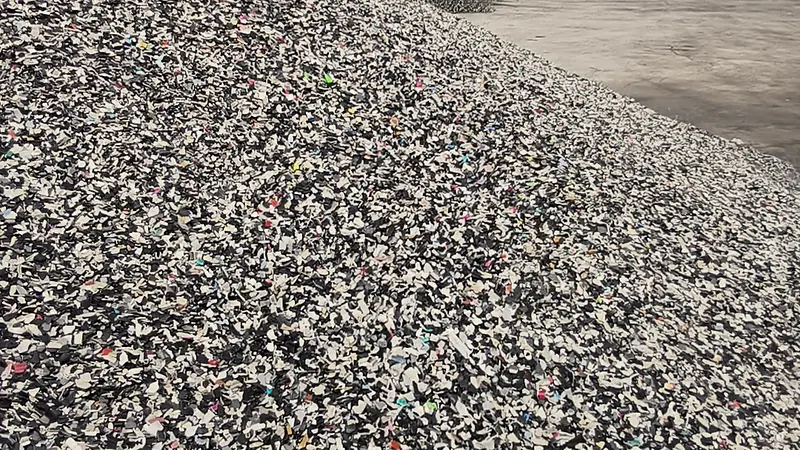
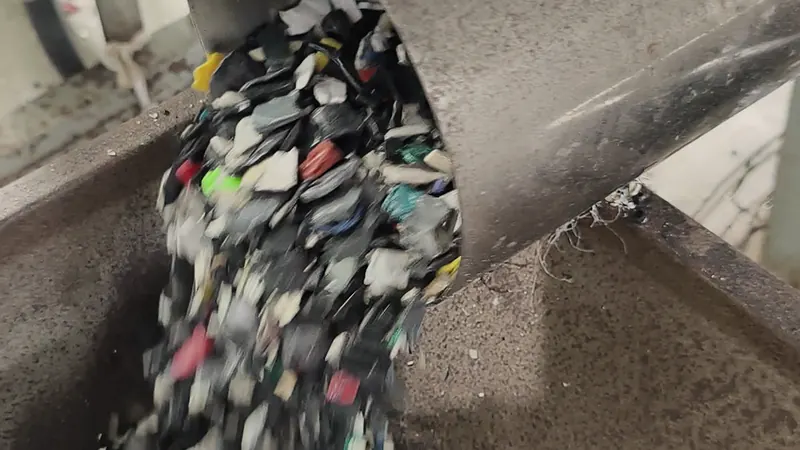
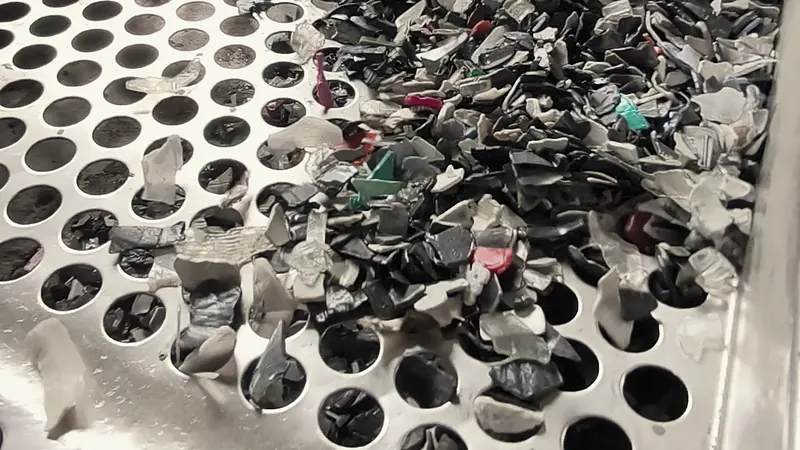
This is Dayatas Profab's glossary of the plastic resin and recycling terms that resin buyers and scrap suppliers meet when dealing with the company, which sells ABS, PS and HIPS for injection moulding. It defines the resins, the forms plastic takes from scrap to resin (crushed product, flake, pellet), the steps between (washing, sorting, extrusion), the datasheet values buyers check, such as melt flow index, and the rules for shipping plastic scrap.
Dayatas Profab's own production footage shows crushed flakes, a washing line and a sorting machine; the pellet and the moulded part are drawn here as the site's marks, and the extruder is filmed on How our resin is made. Each step opens its term below.
ABS (acrylonitrile butadiene styrene) is a thermoplastic made by polymerising styrene and acrylonitrile in the presence of polybutadiene. Each part does a job: the acrylonitrile adds chemical resistance, hardness and rigidity, the styrene a shiny surface and easier processing, and the butadiene toughness. That balance of strength, scratch resistance and finish makes it the resin of electronics housings, automotive parts and household appliances, and injection moulding is the most common way ABS parts are made. Dayatas Profab sells ABS as recycled pellet, made in Malaysia.
A bale is scrap plastic pressed and strapped into a block, so that it can be handled, stored and shipped in less space than loose material. Bales are one of the forms a scrap supplier can offer, alongside loose parts, regrind and flake. A bale is only as useful as what is inside it, so a recycler needs to know what it holds: the source, the polymer if known, how mixed or contaminated it is, and roughly how much each bale weighs. Those are the details to put in a scrap offer to Dayatas Profab.
The Basel Convention is the treaty that controls cross-border shipments of waste, plastic waste included. Its plastic waste amendments took effect on 1 January 2021 and sort plastic scrap into three entries: B3011 for plastic waste presumed not hazardous, made almost entirely of one non-halogenated polymer (PS and ABS among them) or of a PE, PP and PET mixture sent for separate recycling, almost free from contamination and destined for environmentally sound recycling; Y48 for other plastic waste, mixtures included, so a mixed ABS and PS lot, which needs prior informed consent before it crosses a border; and A3210 for plastic waste presumed hazardous. Implementation may vary between the parties to the Convention, and the United States is not a party.
A bulk bag, or flexible intermediate bulk container (FIBC), is a large flexible bag of woven fabric with lifting loops, used to store and move dry, flowable products, plastic flake and granules among them, by forklift or crane. A scrap offer can come in bulk bags, in bales or as loose parts, so say which in the offer. A bulk bag is not the same as the 25 kg bags Dayatas Profab's ABS pellets are packed in.
Contamination is anything in a lot of plastic scrap that is not the polymer being recycled: other plastics, metal, paper, labels, dirt or residues of what the product held. It matters twice. Mixed or contaminated input gives a recycled resin whose properties vary, and the Basel Convention treats plastic waste that is almost free from contamination and destined for recycling (B3011) differently from other plastic waste (Y48), which needs prior informed consent before it crosses a border. Washing and sorting are the steps that remove it.
Crushed product is finished plastic products crushed before they reach a recycler rather than collected whole, so it arrives as broken pieces instead of parts. It is among the plastic scrap Dayatas Profab is looking for, with plastic from home appliance products and automotive parts. What matters to a recycler is still what the product was made of and how mixed it is: crushed product of one known polymer is easier to judge than a crushed mix of everything.
What is the difference between a datasheet and a test report?
A datasheet, or technical data sheet, gives a grade's typical values: the numbers a buyer judges a grade by, such as melt flow index, impact strength, density and tensile properties, each with the standard it was measured to. Typical values describe the grade, not one delivery. A test report is the other half: laboratory results for one specific lot, so it shows what the material you are buying actually measured. Dayatas Profab's spec sheets for ABS, PS and HIPS are not on this site yet; they will be posted on its quality and documents page.
The four datasheet values to read first, and the standard behind each (sources 8, 9, 10, 11, 12, 13)
Value
What it tells a moulder
Test standard
Melt flow index
A first guide to whether the melt will flow like the resin you run now
ISO 1133-1, ASTM D1238
Izod impact strength
How much energy a notched test bar absorbs: a first guide to toughness
Density is the mass of a plastic per unit of volume, given on a datasheet in grams per cubic centimetre. It tells a moulder how heavy a part will be for its volume and helps set the shot size, and a figure far from the datasheet's is a sign that a delivery is not the material it should be. For non-cellular plastics, density is measured by the methods in ISO 1183-1, so check that two sheets name the same method before you compare them.
Drying removes the moisture a resin picks up from the air before it is moulded. ABS absorbs moisture, and water in the melt causes surface defects on the part, so moulders dry ABS in a dryer before it reaches the hopper. Autodesk's Moldflow material notes give 80 to 90 °C for at least two hours, to under 0.1% moisture, as a typical starting point. The grade's datasheet sets the actual drying conditions, so ask for it before the first run.
An end-of-life vehicle (ELV) is a vehicle that has been scrapped, and so a source of automotive plastic scrap. In the EU, end-of-life vehicle rules set targets for how much of each scrapped vehicle is reused, recycled and recovered. Automotive plastic is among the scrap Dayatas Profab is looking for, from suppliers in Europe, America, Japan and Korea. Say in an offer which parts the plastic came from and, where the parts are marked, which polymer they are.
Extrusion pushes material through a die to make a continuous shape: plastic is melted in a screw extruder and shaped as it leaves the die. In recycling the melt leaves as strands, which are drawn through cooling water and cut into pellets: that is pelletising. It is the step that turns washed, sorted flake back into a resin a moulding machine can take. Dayatas Profab's own footage shows molten strands leaving an extruder into cooling water, and fresh pellets on a sieve.
Flake is plastic scrap crushed or ground into small pieces: the stage between a scrap product and a pellet. Crushing brings parts down to a size that can be washed, sorted and fed to an extruder, so flake is washed and sorted before it is melted. Flake of one polymer and one colour recycles into a more consistent resin than a mix. Scrap suppliers sometimes offer material already as flake; if you do, name the polymer and say how it was sorted.
A flame retardant is an additive that slows ignition and the spread of fire in a material. Plastics for electrical and electronic equipment, housings among them, are often flame-retarded so that the part can meet a flammability rating such as UL 94 V-0. Whether a grade contains a flame retardant, and which rating it holds at which wall thickness, belongs on its datasheet; check both before you specify a recycled grade for a housing.
A grade is one formulation of a resin, made and sold with its own datasheet. ABS, PS and HIPS are resins; each comes in many grades, which differ in melt flow, impact strength, colour and additives such as flame retardants. That is why datasheet values belong to a grade, not to a polymer name, and why two offers of ABS can only be compared once both datasheets are side by side. The datasheets for Dayatas Profab's ABS, PS and HIPS are not on this site yet, and will be posted when they are.
HIPS (high impact polystyrene) is polystyrene made tough: a polystyrene matrix with a rubber phase dispersed in it, made by polymerising styrene with dissolved polybutadiene. The rubber improves impact strength, so HIPS goes where general-purpose polystyrene would be too brittle, for example into household appliances such as refrigerators, and into parts that get handled. It keeps polystyrene's ease of processing. Dayatas Profab sells HIPS alongside ABS and PS; whether its HIPS is recycled is being confirmed.
The HS code is the customs number a shipment is declared under in the Harmonized System, the international product classification. Plastic scrap falls under heading 3915, waste, parings and scrap of plastics, which is split by polymer; 3915.20 is scrap of polymers of styrene, the family polystyrene belongs to. The first six digits are shared internationally, while the digits after them, and how a mixed lot is classified, are set by each country's customs. The HS code is not the Basel entry: a scrap shipment's paperwork carries both.
Injection moulding makes parts by injecting molten material, most often a thermoplastic, into a mould, where it cools in the shape of the cavity and is ejected as a finished part. The resin goes into the machine as pellets, through a hopper, which is why resin is sold in that form. It is the process Dayatas Profab's resin is sold for: moulders use the resin for parts such as monitor housings and motorbike covers, and injection moulding is the most common way ABS parts are made.
Izod impact strength is the energy a notched test bar absorbs before it breaks when a swinging pendulum strikes it: the datasheet's measure of toughness. For a moulder it is a first guide to how well a part will take a knock, which is why it matters for housings and covers. It is tested to ISO 180 or to ASTM D256, and the two methods report figures in different units, so check which standard a figure was measured to before you compare two sheets.
Masterbatch is a concentrated mixture of pigments or additives in a carrier resin, added to plastic during processing to colour it or change its properties. A moulder running a natural grade, one with no colour added, can mix masterbatch in at the machine to reach the colour a part needs, instead of buying a pre-coloured grade. Colour is part of a resin enquiry to Dayatas Profab: say whether it matters for your part, and whether you add your own masterbatch.
Mechanical recycling turns plastic scrap back into resin without changing its chemistry: the scrap is crushed into flake, washed, sorted and melted into pellets. It is the most common recycling route, and it works for thermoplastics such as ABS and polystyrene because they melt when heated and harden again as they cool. Heat can degrade a polymer each time it is reprocessed, which is why the input is sorted with care and why recycled and virgin resin are sometimes blended. Dayatas Profab's own footage shows steps on this route, among them a washing line, a sorting machine, an extruder and pellets bagged from a silo.
Melt flow index is the mass of polymer, in grams, that flows through a capillary in ten minutes at a set temperature and load. It is an indirect measure of molecular weight and the first number a moulder checks: a higher figure means a melt that flows more easily, a lower one a stiffer melt. Compare a recycled grade's figure with that of the resin your tool runs now, at the same test conditions; the closer they are, the more likely the melt is to flow as it does today, though a trial in your own tool is the real test. It is tested to ISO 1133-1 or ASTM D1238.
A pellet is the small granule that resin is sold in, and the form a moulding machine's hopper takes. In recycling, pellets are what comes off the extruder once its molten strands are cooled in water and cut: the step that turns washed, sorted flake back into a resin a moulder can use. Dayatas Profab's ABS is sold as recycled pellet, made in Malaysia and packed in 25 kg bags; the form of its PS and HIPS is being confirmed.
What are post-consumer and post-industrial recycled content?
Recycled content is split by where the scrap came from. Post-consumer material (PCR) comes from products that reached their end users, households or businesses, and can no longer serve their purpose, such as a scrapped appliance or vehicle part. Post-industrial, or pre-consumer, material (PIR) is diverted from the waste stream during manufacturing, such as off-cuts or rejected parts. Under ISO 14021, regrind reused within the same process that made it does not count as recycled content. A recycled-content claim should say which kind it means.
The two kinds of recycled content (source 27)
Kind
Where it comes from
Recycled content under ISO 14021?
Post-consumer (PCR)
Products that reached their end users and can no longer serve their purpose
Yes
Post-industrial (PIR)
Material diverted from the waste stream during manufacturing
Yes, except regrind reused in the same process that made it
Under the Basel Convention, prior informed consent is the written consent of the importing country, and of any transit countries, that a controlled waste shipment needs before it leaves. Plastic waste under entry Y48, and hazardous plastic waste under A3210, need it; plastic scrap under B3011, almost entirely one non-halogenated polymer, almost free from contamination and destined for environmentally sound recycling, does not under the Convention. Countries add their own rules. Since 1 July 2025 Malaysia admits waste plastic only with a SIRIM Certificate of Approval, and SIRIM's guidelines (May 2025, clause 3.3) allow it only from countries that are parties to the Basel Convention or that have an agreement or arrangement with Malaysia on waste plastic, one polymer per lot. The EU bans plastic waste exports to non-OECD countries such as Malaysia from 21 November 2026. Check both before anything ships.
PS, or general-purpose polystyrene (GPPS), is a styrenic thermoplastic that is clear, hard and brittle. It is easy to process and suits rigid parts that do not take knocks; where they must, its tougher, rubber-modified form, HIPS, takes over. Polystyrene carries resin identification code 6, which helps pick it out of mixed scrap. Dayatas Profab sells PS alongside ABS and HIPS; whether its PS is recycled, and in what form it is sold, is being confirmed.
Recycled resin is resin reprocessed from plastic scrap rather than made from new feedstock. Thermoplastics such as ABS and polystyrene melt when heated and harden as they cool, so scrap of them can be crushed, washed, sorted, melted and cut into pellets that are moulded again. How consistent a recycled resin is depends on how well its input was sorted. Dayatas Profab's ABS is recycled pellet, made in Malaysia; how it compares with virgin resin is set out on the recycled vs virgin page.
Regrind is plastic ground from scrap or from rejected parts, often fed back into processing. A moulder may regrind its own rejects at the machine and mix a share of it into new resin; under ISO 14021 that in-house regrind does not count as recycled content. A recycler takes regrind from many sources and turns it into pellets. If you offer regrind as a scrap supplier, say which polymer it came from, whether it is one colour or mixed, and how much you have.
Resin is the raw plastic a moulder buys, before it is melted and moulded into a part. It is usually sold as pellets, and each resin, such as ABS, PS or HIPS, comes in grades with their own datasheets. Resin can be virgin, made from new feedstock, or recycled, reprocessed from plastic scrap, and the two are sometimes blended. Dayatas Profab sells three resins for injection moulding, ABS, PS and HIPS, and its ABS is sold as recycled pellet made in Malaysia.
A resin identification code is the number marked on a plastic product to show which plastic it is made of. Polystyrene carries code 6, and ABS falls under code 7, other, which groups the plastics outside codes 1 to 6, so code 7 alone cannot tell ABS from another plastic. Parts are often also marked with the polymer's abbreviation between angle brackets, such as >ABS< or >PS<, as ISO 11469 sets out; on a scrapped appliance or vehicle part that mark is the clearer clue to what a piece of scrap is, and sorting parts by their marks before crushing keeps one polymer apart from another.
Sorting separates scrap by polymer type and colour, so that the resin made from it has consistent properties; mixed or contaminated material gives inconsistent ones. It is the step that decides how consistent a recycled resin can be, and it can start before crushing, with parts picked apart by their marks. Dayatas Profab's own footage shows a sorting machine at work and sorted flakes running into bulk bags.
Tensile strength is the pull a test bar takes before it yields or breaks: how strong the material is under tension. A datasheet gives it with the tensile modulus, which shows how stiff the material is, and the elongation, which shows how far it stretches before it fails. Together they tell a buyer whether a part will hold a clip, a screw boss or a load. ISO 527-2 sets the test conditions for the tensile properties of moulding and extrusion plastics.
What does a test report show that a datasheet does not?
A test report gives laboratory results for one specific lot, measured against named test standards. A datasheet gives typical values for a grade; a test report shows what the material you are buying actually measured, so it is the document to check a delivery against. Buyers in Europe and America ask a lot for test reports. Dayatas Profab's test reports are not on this site yet; they will be posted on its quality and documents page.
What is a thermoplastic and why can it be recycled?
A thermoplastic is a plastic that softens and melts when heated and hardens again as it cools, and can go through that cycle again and again. That is what makes it mouldable and mechanically recyclable: scrap of it can be melted and reshaped into new pellets. ABS, PS and HIPS are all thermoplastics. Thermosets, by contrast, set for good when they cure and cannot be melted down again, which is why they are not recycled into resin this way.
UL 94 is the plastics flammability standard from UL that rates a material by how it burns in a small-flame test: HB from a horizontal test, and V-2, V-1 and V-0 from a vertical test that times how quickly the flame goes out and whether burning drips fall. V-0 is the strictest of the three V ratings, and a rating holds at a stated wall thickness. Electronics housings are often specified with a rating, so check whether a recycled grade carries a listed rating at your wall thickness before you specify it.
Virgin resin is resin made from new feedstock that has never been processed into a product, so its properties are set by the producer's recipe rather than by what a scrap stream contained. Mechanical recycling can degrade a polymer through heat each time it is reprocessed, and blending recycled with virgin material is a common way to offset that. A buyer weighing the two compares their datasheets and test reports value for value, against what the part needs.
A washing line is the run of tanks and agitators that cleans crushed flake before it is sorted and extruded, taking off dirt, labels and residues so that they do not end up in the pellet. Washing comes between crushing and sorting: clean flake is easier to separate by polymer and colour, and contamination left in the flake shows up as variation in the resin. It is one of the steps on the route from plastic scrap to recycled resin.
What is WEEE (waste electrical and electronic equipment)?
WEEE is scrapped electrical and electronic equipment, household appliances included, and so the source of home appliance plastic scrap such as appliance housings. In the EU, the WEEE Directive requires its separate collection and proper treatment, with targets for collection, recovery and recycling. Home appliance plastic is among the scrap Dayatas Profab is looking for, from suppliers in Europe, America, Japan and Korea; say in an offer which appliances the plastic came from.
Dayatas Profab's glossary rests on the standards bodies, regulators, producers and reference works below; each definition names its sources by number. Lines about Dayatas Profab itself come from the company and its own production footage.