
GuideDayatas Profab · Insights
ABS, PS or HIPS: which resin should you use for an injection-moulded part?
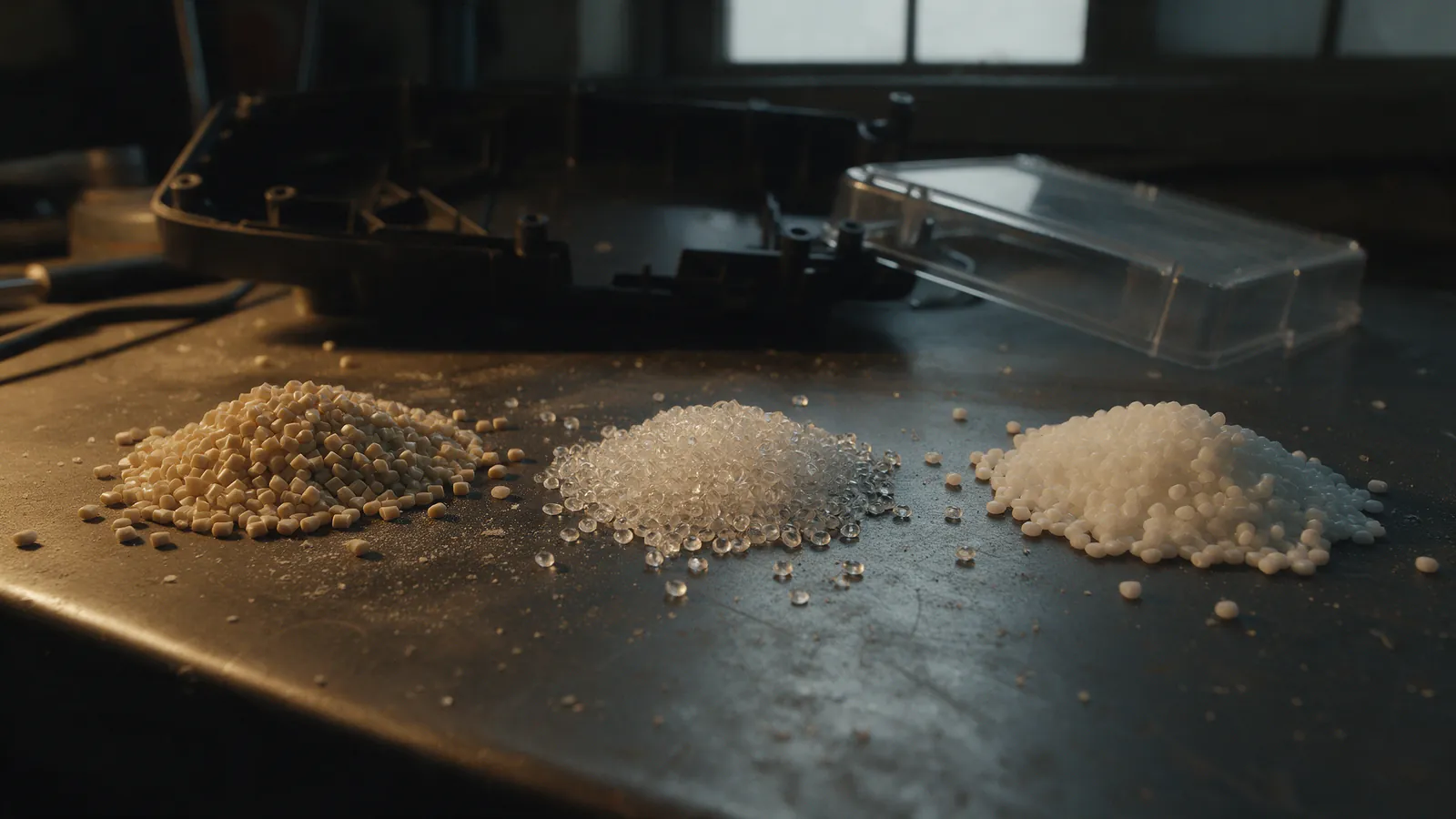
For an injection-moulded part, choose PS (general-purpose polystyrene) for clear, rigid parts kept away from impacts, HIPS (high-impact polystyrene) for parts that take everyday knocks, and ABS (acrylonitrile butadiene styrene) for strong housings and covers with a scratch-resistant finish. The choice also changes the press: ABS must be dried before it is moulded. Dayatas Profab sells all three resins.
On this page10
✓Key takeaways
- PS is clear, hard and brittle: the resin for rigid, see-through parts such as transparent housings and light diffusers (sources 1, 5).
- HIPS is polystyrene with a rubber phase dispersed in it, a more durable plastic than general-purpose PS, used in household appliances such as refrigerators (sources 1, 3).
- ABS is an engineering plastic favoured for strength, scratch resistance and finish (source 3), and monitor housings and motorbike covers are among the products moulders make with Dayatas Profab's resin.
- At the press, ABS must be dried before moulding and runs at 50 to 100 MPa injection pressure, against 20 to 60 MPa for general-purpose PS, which usually needs no drying (sources 4, 5).
- In the part design, Protolabs recommends walls of about 1.1 to 3.6 mm for ABS and 0.9 to 3.8 mm for polystyrene, so a thin PS wall may need thickening in ABS (source 6).
Which of ABS, PS and HIPS suits your part?
PS (general-purpose polystyrene) suits clear, rigid parts kept away from impacts. HIPS suits parts that take everyday knocks but need no more than a tougher polystyrene. ABS suits parts that need strength, a scratch-resistant finish and resistance to chemicals, or that must survive drops. The property-by-property comparison is on ABS vs PS vs HIPS; this guide covers what each choice means at the press and in the part design.
- PS, for clear and rigid parts. Autodesk's Moldflow guidance notes that most commercial PS grades are clear, and lists packaging, housewares such as tableware and trays, and transparent housings and light diffusers among their uses (source 5). Polystyrene can also be coloured (source 1).
- HIPS, for parts that take knocks. HIPS is a continuous polystyrene matrix with a rubber phase dispersed in it (source 1), and INEOS names household appliances such as refrigerators as its use (source 3).
- ABS, for strength, finish and drops. ABS is known for its excellent impact resistance (source 7), and Autodesk lists automotive instrument panels and trim, refrigerators, small appliance housings, power tools and telephone housings among its uses (source 4). Monitor housings and motorbike covers are among the products moulders make with our resin.
Refrigerators appear among the uses of both ABS (Autodesk) and HIPS (INEOS).
Should you mould ABS or HIPS?
Mould ABS when the part needs strength, a scratch-resistant finish or resistance to chemicals; mould HIPS when a tougher polystyrene is enough. Both get their toughness from a dispersed rubber phase (sources 4, 1). ABS adds acrylonitrile, which brings hardness and chemical and heat resistance (source 4), and ABS is an engineering plastic, a class that costs more than commodity plastics such as polystyrene (source 9).
Autodesk describes ABS as an amorphous terpolymer with two phases: a continuous phase of styrene-acrylonitrile (SAN) and a dispersed phase of polybutadiene rubber. Because the ratios of the three monomers can be varied, there are hundreds of ABS grades on the market, from medium to high impact and from low to high gloss (source 4). In short, choosing ABS over HIPS means paying for an engineering plastic to gain strength, finish and chemical resistance.
What changes at the press when you mould ABS, PS or HIPS?
Drying comes first. ABS takes up moisture and must be dried before moulding, while general-purpose PS usually goes into the hopper as it is. ABS also runs at higher injection pressures than PS in Autodesk's Moldflow guidance, and on ABS the mould temperature sets the gloss. The sources used here publish no general processing window for HIPS, so the grade's datasheet sets it.
“ABS grades are hygroscopic and drying is required prior to processing.”
Autodesk Moldflow, guidance on ABS materials (source 4)
| Setting | ABS | General-purpose PS |
|---|---|---|
| Drying | Required: 80 to 90 °C for at least 2 hours, to below 0.1% moisture | Not usually required unless stored improperly; if needed, 2 to 3 hours at 80 °C |
| Melt temperature | 200 to 280 °C, aim 230 °C | 180 to 280 °C; at most 250 °C for flame-retardant grades |
| Mould temperature | 25 to 80 °C; a cooler mould gives lower gloss | 20 to 70 °C |
| Injection pressure | 50 to 100 MPa | 20 to 60 MPa |
| Injection speed | Moderate to high | Fast |
These are starting windows, not a recipe: the grade's datasheet and a trial on your own tool set the final values. A moulder moving a part from PS to ABS plans for a dryer at the press and a higher injection pressure. To ask which of our resins suits your press, use the buyer enquiry form.
How thick should the walls be, and how much will the part shrink?
Protolabs recommends walls of about 1.1 to 3.6 mm (0.045 to 0.140 in.) for ABS and about 0.9 to 3.8 mm (0.035 to 0.150 in.) for polystyrene (source 6). Protolabs does not list HIPS. For shrinkage, Autodesk gives 0.4 to 0.7% for general-purpose PS (source 5); for ABS and HIPS, the value comes from the grade's datasheet.
Protolabs warns that “very thick parts will lead to cosmetic and structural problems like voiding and warping” (source 6). A PS part designed with walls under about 1.1 mm sits below Protolabs' recommended minimum for ABS, so moving that part to ABS for toughness can mean thickening its walls. ISO 294-4 measures shrinkage both along the direction of melt flow and across it (source 12), so ask for both values before the mould is made.
How do you get a good finish on a moulded ABS or PS part?
On ABS, the finish is set at the press as much as by the resin: the mould temperature controls the gloss, and moulding ABS at a high temperature improves both its gloss and its heat resistance (sources 4, 2). On general-purpose PS, the finish is clarity: polystyrene is naturally transparent and can be coloured (source 1).
ABS parts can also be painted and glued, and bonded to each other with solvents (source 2), which matters for a housing assembled from several mouldings. Our own ABS, recycled pellet made in Malaysia, is described on ABS resin (recycled pellet).
Which resin handles heat, sunlight and a flame rating?
ABS and polystyrene both soften at about 100 to 105 °C: ABS has a glass transition temperature of about 105 °C (source 2), and polystyrene flows if heated above about 100 °C (source 1). A part near a motor or electronics is therefore checked against the grade's heat deflection temperature. ABS and polystyrene both degrade in sunlight (sources 2, 7, 1), and housings for electronics are often specified to a UL 94 flame class (source 8).
- Heat. Heat deflection temperature is measured to ISO 75-2, which specifies three methods using different values of constant flexural stress (source 10), or to ASTM D648 (source 11). Compare two grades only on the same method.
- Sunlight. ABS yellows when exposed to UV light (source 2), and Protolabs notes that it can become brittle and discoloured over time, which limits its outdoor use (source 7). Polystyrene is susceptible to photo-oxidation (source 1). For an outdoor part such as a motorbike cover, ask whether the grade is meant for outdoor use, or plan for the part to be painted or otherwise protected.
- Flame. UL 94 sorts materials for enclosures, structural parts and insulators into the classes HB, V-2, V-1, V-0, 5VB and 5VA; a V-rated material self-extinguishes within a specified time once the flame is removed (source 8). ABS on its own is combustible, and flame-retardant additives improve its fire resistance (source 7).
A flame-retardant grade is a different resin at the press as well: Autodesk's guidance caps the melt temperature of flame-retardant PS grades at 250 °C, against 280 °C for standard PS (source 5). What each UL 94 class means for a monitor housing, and which documents prove it, is on quality and documents.
What changes when the ABS, PS or HIPS is recycled?
The way to choose between ABS, PS and HIPS does not change when the resin is recycled; how closely each lot is checked does. A recycled grade is judged on its datasheet and on a test report for the lot. Recycled vs virgin resin sets out what recycled content changes.
Our ABS is recycled pellet, made in Malaysia and packed in 25 kg bags printed “ABS RECYCLED PELLET”. Dayatas Profab's own production footage follows it from plastic scrap in a yard, through washing and sorting, to molten strands leaving an extruder and pellets bagged from a silo; the picture at the top of this page is one frame of it, sorted flakes dropping from a hopper bag. For our PS and HIPS, ask us for the details: see PS resin and HIPS resin.
Buyers in Europe and America regularly ask Dayatas Profab for resin specs, certification, test reports and video of the production. Our production film is ready; spec sheets and test reports are to come; certification and licences are to come. For a recycled lot of any of the three resins, ask for the following (melt flow, Izod impact and UL 94 are explained in the glossary):
- Melt flow, as MFR or MVR measured to ISO 1133-1 (source 13) or ASTM D1238 (source 14).
- Izod impact strength, measured to ISO 180 (source 15) or ASTM D256 (source 16): the toughness your choice of resin was built on.
- Heat deflection temperature and moulding shrinkage, when the part runs warm or the mould is already made (sources 10, 12).
- The UL 94 class, when the part is an electronics housing (source 8).
- A RoHS declaration, when the part goes into electrical or electronic equipment sold in the EU: the RoHS Directive restricts ten substances in such equipment, including lead, cadmium and the brominated flame retardants PBB and PBDE (source 17).
Common questions about moulding ABS, PS and HIPS
Is PS cheaper than ABS?
Usually, yes. ABS is an engineering plastic and polystyrene a commodity plastic, and engineering plastics are more expensive than standard plastics; Autodesk's Moldflow guidance also calls PS an inexpensive polymer. Prices still move with the grade and the market, so compare quotations for the grades on your shortlist. (sources 9, 5)
Is ABS stronger than HIPS?
In general, yes. ABS is known for its excellent impact resistance and is an engineering plastic, a class with better mechanical or thermal properties than commodity plastics such as polystyrene; HIPS is a polystyrene made tougher by a rubber phase. For a part that must survive drops or carry loads, start with ABS, and compare grades on Izod impact strength measured to the same standard. (sources 7, 9, 1)
Does PS need drying before injection moulding?
General-purpose PS usually does not: Autodesk's guidance says drying is not usually required unless the resin was stored improperly, and gives 2 to 3 hours at 80 °C when it is. ABS needs drying before it is moulded. For HIPS, follow the grade's datasheet. (sources 5, 4)
Which resin is used for monitor housings?
ABS is a common choice: it is used for enclosures of electrical and electronic assemblies such as computer cases. Monitor housings are among the products moulders make with our resin. Housings for electronics are often specified to a UL 94 flame class. (sources 2, 8)
How do you ask Dayatas Profab for ABS, PS or HIPS?
Dayatas Profab needs five details to match a resin to your part: the part, what it meets in use (knocks, heat, sunlight, a flame class), the finish, the quantity and the destination port. With them, we can suggest a resin and say which documents are ready for it. Our three resins are on ABS, PS and HIPS resin, and the parts moulders make with each are on what moulders make with ABS, PS and HIPS. To ask about a resin, use our buyer enquiry form.
Sources
- Wikipedia: Polystyrene: general-purpose PS clear, hard and brittle; HIPS a polystyrene matrix with a dispersed rubber phase; colour; flows above about 100 °C; photo-oxidation
- Wikipedia: Acrylonitrile butadiene styrene: glass transition; gloss and moulding temperature; painting, gluing and solvent bonding; yellowing in UV light; enclosures such as computer cases
- INEOS: Styrenics: ABS strength, scratch resistance and finish; HIPS in household appliances such as refrigerators
- Autodesk Moldflow: ABS materials: drying, melt and mould temperature, injection pressure and speed; the two phases and the monomers; grades; typical uses
- Autodesk Moldflow: PS materials: drying, melt and mould temperature, injection pressure and speed, shrinkage; clear grades; typical uses; cost
- Protolabs: Solving wall thickness issues in molded parts: recommended wall thickness for ABS and polystyrene
- Protolabs: ABS: impact resistance; sunlight and UV; combustibility and flame-retardant additives
- UL Solutions: combustion (fire) tests for plastics, UL 94: the UL 94 flame classes and where they are used
- Wikipedia: Engineering plastic: ABS the most-consumed engineering plastic; engineering plastics cost more than commodity plastics such as polystyrene
- ISO 75-2:2013, temperature of deflection under load: heat deflection temperature, three methods
- ASTM D648, deflection temperature of plastics under flexural load: heat deflection temperature
- ISO 294-4:2018, determination of moulding shrinkage: moulding shrinkage, along and across the flow
- ISO 1133-1:2022, melt mass-flow rate (MFR) and melt volume-flow rate (MVR): melt flow
- ASTM D1238, melt flow rates of thermoplastics by extrusion plastometer: melt flow
- ISO 180:2023, Izod impact strength of plastics: impact strength
- ASTM D256, Izod pendulum impact resistance of plastics: impact strength
- European Commission: Restriction of Hazardous Substances in Electrical and Electronic Equipment (RoHS): the ten restricted substances and the products that must comply
Two doors into Dayatas Profab A · buyers of resin B · suppliers of scrap