
GuideDayatas Profab · Insights
What should a recycled resin datasheet show before you buy?
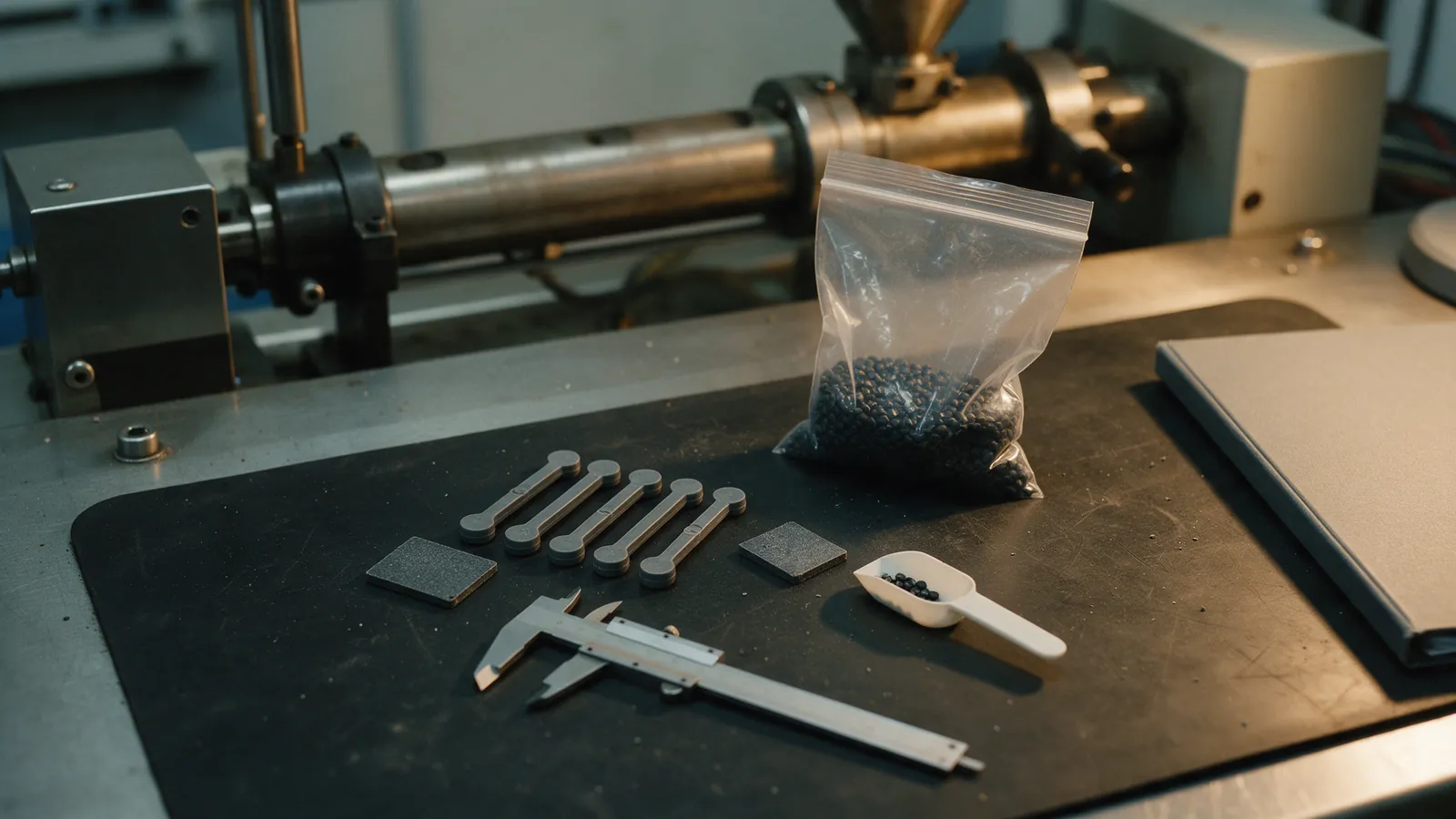
A recycled resin datasheet should give every value with its test standard and its test conditions, state how much of the resin is recycled and where the scrap came from, and list the checks that catch contamination, such as ash. Its values are typical, not guaranteed, so pair it with agreed limits and a test report for each lot. Dayatas Profab's own datasheets are to come.
On this page9
✓Key takeaways
- Conditions, not just numbers. ISO 1133-1 measures melt flow under a set temperature and load and normally leaves both to the material standard (source 1), so a value is only usable with its standard and conditions beside it. The core datasheet properties are listed on quality and documents.
- Two ABS datasheets, nothing comparable. A virgin Terluran ABS sheet gives melt volume rate at 220 °C and 10 kg to ISO 1133 and Charpy impact (source 3); a published recycled ABS sheet gives melt flow at 230 °C and 3.8 kg to ASTM D1238 and Izod impact (source 4).
- Typical is not a promise. That recycled ABS sheet says its data “should not be used to establish specification limits” (source 4): limits are agreed separately, and each lot is proved by its own test report.
- Recycled rows. Ask for the recycled share by weight and whether it is pre- or post-consumer (source 11), plus moisture, ash and a check for other polymers (sources 13, 14, 10).
- Lot to lot, start with melt flow. ASTM calls the melt flow test particularly useful for quality control, but it shows uniformity of flow only, not of other properties (source 2).
Why does every value on a recycled resin datasheet need its test conditions?
Every value on a recycled resin datasheet needs its test conditions because the same resin gives different numbers under different conditions. ISO 1133-1, the melt flow standard, measures flow under specified conditions of temperature and load, and normally leaves those conditions to the material standard (source 1). A melt flow figure with no temperature and load beside it cannot be compared with anything, least of all with the grade already in your press.
“The flow rate obtained with the extrusion plastometer is not a fundamental polymer property.”
ASTM D1238, Significance and Use 5.3 (source 2)
ASTM goes on to call the flow rate an empirical figure, critically influenced by the conditions of measurement (source 2). Two published ABS datasheets show what that means in practice. INEOS Styrolution's flyer for its virgin Terluran ABS grades gives melt volume rate in cm³/10 min at 220 °C under a 10 kg load to ISO 1133, notched Charpy impact to ISO 179/1eA at 23 °C and at −30 °C, heat deflection by method A after annealing, and Vicat softening by method B50 (source 3). A recycled ABS datasheet published by Vinmar Polymers America gives melt flow in g/10 min at 230 °C under 3.8 kg to ASTM D1238, and notched Izod impact in J/m to ASTM D256 (source 4). Both describe ABS, yet no figure on one sheet can be set beside its counterpart on the other.
| Property | The condition to read | Why it changes the number |
|---|---|---|
| Melt flow (MFR in g/10 min, or MVR in cm³/10 min) | Test temperature and load, for example 220 °C and 10 kg | ISO 1133-1 measures flow under the temperature and load the material standard sets |
| Notched impact strength | Charpy (ISO 179-1) or Izod (ISO 180, ASTM D256); the notch; the test temperature, such as 23 °C or −30 °C | ISO 180 sets its test parameters by material, specimen and notch type; ASTM D256 lets the material specification set specimen preparation and conditioning |
| Heat deflection temperature | Method A (1.80 MPa), B (0.45 MPa) or C (8.00 MPa); annealed or not | ISO 75-2's three methods load the bar at different stresses |
| Vicat softening temperature | Method A50, B50, A120 or B120 | ISO 306's four methods differ in force (10 N or 50 N) and heating rate (50 or 120 °C/h) |
Compare a recycled grade with the virgin grade your tool runs now only when both were measured to the same standard under the same conditions. If they were not, ask the supplier for the recycled grade measured the way your current datasheet was. Why ISO and ASTM impact figures also differ in their units is covered on quality and documents, and each term is defined in the glossary.
What should a recycled resin datasheet show that a virgin one does not?
A recycled resin datasheet should also describe the material's history: how much of it is recycled, where the scrap came from, and how clean the pellet is. Intertek, the testing group, notes that challenges with recycled plastics arise from potential variations in feedstock composition and contamination, and that coatings, colorants, additives and ink coverage further affect a recyclate's quality and appearance (source 10).
- The recycled share, by weight. Under the US Federal Trade Commission's Green Guides, recycled content is material diverted from the waste stream during manufacturing (pre-consumer) or after consumer use (post-consumer), and a product that is only partly recycled should state the amount or percentage of recycled content by weight (source 11). The glossary explains the two kinds.
- Where the scrap came from. EN 15343 sets out the procedures for the traceability of recycled plastics, which are the basis for calculating a product's recycled content (source 12). A named source, such as home appliance plastic, automotive parts or crushed product, tells a buyer what the resin may have carried from its first life.
- Colour. The recycled ABS above is sold in a mixed-colour version and a black one (source 4).
- Moisture. ABS is hygroscopic and must be dried to below 0.1% moisture before moulding (source 13), so a moisture figure for the resin as packed tells the moulder how much drying to plan.
- Ash. Ash content, determined to ISO 3451-1, whose conditions can be written into a material's specification (source 14), is the residue left when the plastic is burnt away: a figure that rises from lot to lot is worth a question.
- Other polymers. Mixed polymer types are what make recycled plastic vary from batch to batch, NETZSCH notes (source 15), and laboratories identify a polymer and its contaminants with methods such as infrared spectroscopy (FTIR) (source 10). Ask whether the lot was checked for other polymers.
For polystyrene, Europe has a standard for exactly this conversation: EN 15342 specifies the main characteristics and test methods for assessing PS recyclates, to help the parties agree on specifications (source 16).
Is a datasheet value a promise about your lot?
A datasheet value is not a promise about your lot: it is a typical value for the grade. The recycled ABS datasheet quoted above says its data fall within the normal range of the product's properties and are not to be used to set specification limits (source 4). What binds a supplier is an agreed specification, with limits on the properties your part depends on, and a test report showing each lot inside them.
“The data listed herein falls within the normal range of product properties, but they should not be used to establish specification limits or used alone as the basis of design.”
Vinmar Polymers America, datasheet for a recycled ABS (source 4)
Agree limits on the two or three properties that matter to the part, for example a melt flow window at stated conditions and a minimum notched impact strength, plus a moisture limit where the resin is ABS. How a datasheet differs from a lot's test report, and the three things to check on that report, are on quality and documents and in the glossary.
How do you check lot-to-lot consistency on recycled ABS, PS or HIPS?
Check melt flow on every lot of recycled ABS, PS or HIPS, and impact strength often enough to catch a drift. ASTM calls the melt flow test particularly useful for quality control, and says its data indicate the uniformity of a polymer's flow, not of its other properties (source 2). NETZSCH notes that quality variations across batches are why many manufacturers hesitate to use recycled plastics (source 15).
- Agree the limits first. Before the first order, put the melt flow window, the minimum impact strength and the moisture limit in writing, each with its standard and conditions.
- Ask for each lot's test report. The melt flow on it should be measured at the same conditions as the datasheet.
- Ask for a run of lots, not one. Melt flow results for recent lots show the spread that a single typical value on a datasheet cannot.
- Watch which way melt flow moves. A higher melt flow rate corresponds to a lower molecular weight (source 17), so a figure that climbs from lot to lot is worth asking about.
- Test impact when melt flow moves. Melt flow does not show the uniformity of other properties (source 2), so ask for notched impact strength at an agreed interval, and whenever melt flow shifts.
- Keep a sample and run a trial. Keep a retained sample of each lot, and run a trial in your own mould before production; recycled vs virgin resin explains why a recycled grade varies more than a virgin one.
What are the warning signs on a recycled resin datasheet?
The warning signs on a recycled resin datasheet are gaps rather than bad numbers: a missing standard, a missing condition, a missing date or a missing recycled share. None of them proves that the resin is poor, but each one is a question to put to the supplier before you order:
- values with no test standard, or no temperature and load beside the melt flow;
- an impact figure with no method (Charpy or Izod), no notch and no test temperature;
- no revision date (the recycled ABS sheet quoted above carries one (source 4));
- the word “recycled” with no share by weight (source 11);
- figures identical to a well-known virgin grade's, with nothing to say they were measured on the recycled material;
- no test report offered for the lot you are buying.
Where does Dayatas Profab stand on datasheets?
Dayatas Profab's spec sheets for its ABS, PS and HIPS are to come, and no datasheet value for them is quoted on this site until they are published. Buyers in Europe and America regularly ask Dayatas Profab for resin specs, certification, test reports and video of the production. Our production film is ready, our test reports are being prepared, and our certification and licences are to come.
Our ABS is recycled pellet, made in Malaysia and packed in 25 kg bags printed “ABS RECYCLED PELLET”: see ABS resin. For our PS resin and HIPS resin, ask us for the details. The picture at the top of this page is a frame of Dayatas Profab's own footage: a bulk bag of dark flakes flecked with other colours, the kind of material whose history a recycled datasheet has to account for. Which of the three resins suits a moulded part is covered in ABS, PS or HIPS for an injection-moulded part. When our sheets are published, hold them to the same list as anyone else's.
Common questions about recycled resin datasheets
Can I compare an ISO datasheet with an ASTM datasheet?
Not value for value. Melt flow depends on the temperature and load it was measured at. A virgin ABS sheet gives Charpy impact and melt volume rate at 220 °C and 10 kg, a recycled ABS sheet Izod impact and melt flow at 230 °C and 3.8 kg. Ask for the recycled grade measured the way your current grade's datasheet was. (sources 1, 3, 4)
Which property should I check on every lot of recycled resin?
Melt flow. ASTM describes the melt flow test as particularly useful for quality control and as an indicator of the uniformity of a polymer's flow. It says nothing on its own about other properties, so add notched impact strength at an agreed interval, or whenever the melt flow moves. (source 2)
Should a recycled resin datasheet state the recycled content?
Ask for it in writing either way. In the US, the FTC's Green Guides expect a product that is only partly recycled to state the amount or percentage of recycled content by weight, and a claim that splits pre-consumer from post-consumer content needs substantiation. In Europe, EN 15343 sets out the traceability procedures that a recycled-content figure is calculated from. (sources 11, 12)
Why does moisture matter on a recycled ABS datasheet?
ABS is hygroscopic: it takes up water and must be dried before moulding, to below 0.1% moisture in Autodesk's Moldflow guidance. A moisture figure for the resin as packed tells you how much drying to plan before the first shot. (source 13)
Does Dayatas Profab publish datasheets for its ABS, PS and HIPS?
Not yet. Dayatas Profab's spec sheets for its ABS, PS and HIPS are to come, and no datasheet value for them is quoted on this site until they are published. To ask about a resin in the meantime, use the buyer enquiry form.
How do you ask Dayatas Profab for a datasheet?
To ask Dayatas Profab for a datasheet, tell us the resin you need, the part, the datasheet of the grade you run now, the quantity and the destination port. Your current datasheet shows us which standards and conditions you compare against. The documents that go with our resin, and where each one stands, are on quality and documents. To ask about a resin, use our buyer enquiry form.
Sources
- ISO 1133-1:2022, melt mass-flow rate (MFR) and melt volume-flow rate (MVR): MFR and MVR under specified conditions of temperature and load; conditions normally set in the material standard
- ASTM D1238, melt flow rates of thermoplastics by extrusion plastometer: Significance and Use 5.1 to 5.3: quality control, uniformity of flow only, not a fundamental polymer property
- INEOS Styrolution: Terluran (ABS) flyer, EMEA: virgin ABS grades: MVR at 220 °C / 10 kg (ISO 1133), notched Charpy (ISO 179/1eA) at 23 °C and −30 °C, HDT A annealed, Vicat VST/B/50
- Vinmar Polymers America: VERDANT RRAB0602 Series, recycled ABS datasheet (rev. 30 Nov 2023): recycled ABS: melt flow at 230 °C / 3.8 kg (ASTM D1238), notched Izod in J/m (ASTM D256), mixed colour and black versions, typical-value disclaimer
- ISO 179-1:2026, Charpy impact properties of plastics: Charpy impact strength under defined conditions
- ISO 180:2023, Izod impact strength of plastics: test parameters set by the type of material, specimen and notch
- ASTM D256, Izod pendulum impact resistance of plastics: 5.1: the material specification's specimen preparation, conditioning and test parameters take precedence
- ISO 75-2:2013, temperature of deflection under load: methods A (1.80 MPa), B (0.45 MPa) and C (8.00 MPa)
- ISO 306:2022, Vicat softening temperature: methods A50, B50, A120 and B120: 10 N or 50 N, 50 or 120 °C/h
- Intertek: recycled plastics analysis: variation in feedstock composition and contamination; coatings, colorants, additives and ink; FTIR for polymer identity, XRF for metals and fillers
- US Federal Trade Commission, Green Guides, 16 CFR 260.13: recycled content claims: pre-consumer and post-consumer material; partial recycled content stated as amount or percentage by weight
- EN 15343:2007, plastics recycling traceability and assessment of conformity and recycled content: traceability procedures, the basis for calculating recycled content
- Autodesk Moldflow: ABS materials: ABS is hygroscopic; dry before processing, to below 0.1% moisture
- ISO 3451-1:2026, determination of ash of plastics: general methods for the ash of plastics; conditions can be written into a material specification
- NETZSCH Analyzing & Testing: how to control the quality of recycled plastic materials: mixed polymer types cause quality variation across batches of recyclate
- EN 15342:2025, characterization of polystyrene (PS) recyclates: main characteristics and test methods for PS recyclates, to help parties agree on specifications
- Wikipedia: Melt flow index: melt flow rate is an indirect measure of molecular weight; high melt flow rate means low molecular weight
Two doors into Dayatas Profab A · buyers of resin B · suppliers of scrap