
GuideDayatas Profab · Insights
Which plastics in a scrapped TV, monitor or appliance are ABS, HIPS or PS?
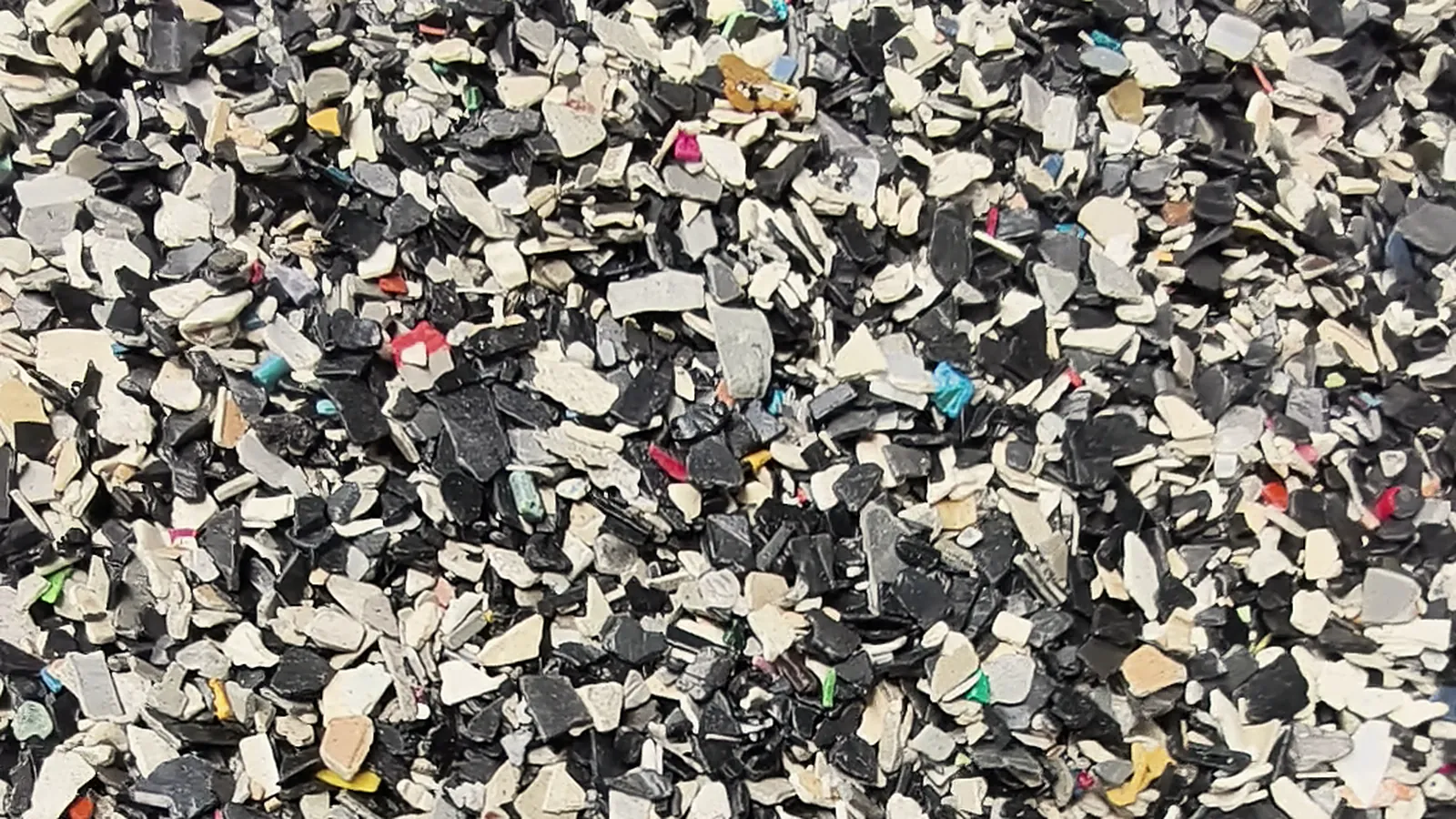
In scrapped TVs, monitors and computers, most housing plastic is HIPS or ABS, with some ABS/PC blends and PPO; refrigerators use HIPS, and ABS is common across household appliances. In one US study of collected electronics, HIPS was 82% of the television plastics. Telling them apart takes identification, not the eye, and many TV and monitor housings carry brominated flame retardants, so a buyer will ask what the scrap came from.
On this page10
Dayatas Profab, a Malaysian company that makes recycled ABS, PS and HIPS resin for injection moulders, is looking for plastic scrap from home appliances, vehicles and crushed product, from suppliers in Europe, America, Japan and Korea. This guide is for holders of appliance and electronics scrap who want to know which of their plastic is ABS, HIPS or PS before they offer it; what we look for is on our page for scrap suppliers. Most of the measured figures below come from CRT-era TVs and monitors; they describe older sets, not today's flat screens.
✓Key takeaways
- TV housings were mostly HIPS. In a US sample of collected electronics, HIPS was 82% of television plastics (source 2).
- Computer plastics leaned to ABS. ABS was the main resin in computer plastics, at 39%, in the same sample (source 2).
- CRT housings are mainly three plastics: ABS, HIPS and ABS/PC (source 1).
- Refrigerators use HIPS. HIPS is a durable polystyrene used in household appliances such as refrigerators (source 4).
- Colour is only a first cut. Black TV plastics are mostly PS and white computer plastics mostly ABS, but proper sorting needs equipment (source 1).
Which plastics are in a scrapped TV or monitor?
A scrapped TV or monitor housing is usually HIPS or ABS, sometimes an ABS/PC blend or PPO. HIPS, high-impact polystyrene, is a toughened grade of PS, so a TV back cover sorted as HIPS belongs with the PS family. Which one a given set uses cannot be read off its age or other basic data; it has to be identified. More on monitor housings is in is recycled ABS good enough for monitor housings.
The Oeko-Institut's report on recycling options for WEEE plastics (October 2014) says: “Regarding CRT monitors and CRT TVs, the most relevant plastics are ABS, HIPS and ABS/PC but it seems not possible to estimate the composition of used plastics by only knowing framework data like for example year of manufacture” (source 1).
In one large sample, television plastic was 82% HIPS. A study presented at the Society of Plastics Engineers' recycling conference in November 2000, from a Minnesota project that collected about 700 tons of end-of-life electronics, found television plastics were 82% HIPS, 7% PPO and 5% ABS, and reported: “HIPS was clearly the predominant resin in television plastics whereas ABS was the predominant resin in both computer and miscellaneous plastics.” (source 2). The sets were collected in 2000, in the CRT era, so the study says nothing about today's flat screens.
Which plastics are in computers and other electronics?
Computer and small-electronics plastic leans towards ABS, mixed with HIPS, PPO, PC/ABS and some PVC: in the same US sample, computer plastics were 39% ABS, 25% HIPS and 17% PPO. That makes a lot of mixed electronics housings less uniform than a lot of TV backs, and sorting matters more before it is offered.
| Resin | Television plastics | Computer plastics | Miscellaneous plastics | Whole sample |
|---|---|---|---|---|
| HIPS | 82% | 25% | 22% | 56% |
| ABS | 5% | 39% | 41% | 20% |
| PPO | 7% | 17% | 4% | 11% |
| PC/ABS | 0% | 6% | 7% | 3% |
| PVC | <1% | 5% | 15% | 3% |
| PP or PE | 0% | 3% | 8% | 2% |
| PC | 1% | 4% | 1% | 2% |
| Other | <1% | <1% | 2% | <1% |
| Unidentified | 5% | 0% | 0% | 3% |
The study's miscellaneous category was “all other communication and household electronic goods”. Across the whole sample, it reported, “HIPS was the predominant resin at 56 percent, followed by ABS at 20 percent and PPO at 11 percent.” (source 2). PVC parts are not what an ABS, PS or HIPS lot for Dayatas Profab should contain.
Which plastics are in fridges and other home appliances?
Refrigerator parts are commonly HIPS, and ABS is used widely across household appliances. The sources here give no measured shares for fridges or washing machines, so an appliance lot, like a TV lot, has to be identified part by part.
HIPS is the durable polystyrene used in refrigerators. INEOS, a styrenics producer, describes two basic types of PS: “GPPS is used in sectors like food packaging, while HIPS is a more durable plastic used in household appliances such as refrigerators.” Of ABS it says: “Primary uses are in the production of automotive parts, consumer electronics and household appliances.” (source 4). Which parts of an appliance Dayatas Profab looks for is on home appliance plastic scrap, and the resin itself on HIPS resin.
How much of a CRT TV or monitor is housing plastic?
About a sixth by weight. The Oeko-Institut report's average, compiled from earlier weighing studies, puts the thermoplastic housing at 17.4% of a CRT TV or monitor: 4.2 kg of a 24.1 kg TV and 2.5 kg of a 14.2 kg monitor (source 1).
A tonne of whole CRT sets therefore holds far less housing plastic than a tonne of dismantled housings. When offering scrap, say whether it is whole appliances, dismantled housings or crushed plastic.
Can you tell ABS from HIPS by looking?
Not reliably. Colour gives a rough first cut: black TV plastics are mostly PS, and light computer plastics mostly ABS. Beyond that, identifying the polymers properly needs equipment, which is why a sorted lot, with a note of how it was sorted, is easier for a buyer to price.
A colour pre-sort is the one step that needs no equipment. The Oeko-Institut report says: “The only pre-separation step that can be done without technical assistant is the differentend collection of black TV plastics that are mostly formed of PS plastics and white Computer plastics which are mostly made of ABS plastic.” It adds that this step “would reduce the downstream separation effort and potentially increase the achieved prices” (source 1).
For the rest, the Oeko-Institut report puts it plainly: “the broad variety of polymer types makes it unsuitable to differentiate properly without using special technical equipment” (source 1). In the Minnesota project, the plastics were identified by resin type “using equipment developed, in part, by APC” (the American Plastics Council), and a separation process then recovered a nearly pure stream of flame-retardant television HIPS, 48 percent of all the television plastics fed in and 67 percent of the HIPS available (source 2).
Why do flame retardants matter in appliance plastic scrap?
Because TV and monitor housings often carry brominated flame retardants, and one of them, commercial decaBDE, is listed in Annex A of the Stockholm Convention.
Around 70% of TV and monitor housings tested carried brominated flame retardants. The Oeko-Institut report cites 149 housing samples, 35 from TVs and 114 from monitors: “Around 70% of the plastics were added with BFR. In 45% of the samples a bromine concentration between 6% and 10% by weight was found”. It notes that Deca-BDE “is added to either ABS, HIPS, PP or PE and very common in EEE”, and that TV and monitor housings made of PPO/PS “apparently are not added with bromine containing FR” (source 1).
The Stockholm Convention on Persistent Organic Pollutants lists commercial decaBDE in its Annex A, and its page on alternatives says “up to 90% of c-decaBDE ends up in plastic and electronics” (source 3). What that means for a particular shipment depends on the countries involved; the rules on the route are set out in how to sell plastic scrap to a recycler overseas.
Dayatas Profab has had its own resin screened. Yue Ce Testing Center in Dongguan, China, screened samples of our black ABS and PS pellets by X-ray fluorescence against the EU RoHS directive, in reports dated 28 September 2026: total bromine 132 ppm in the ABS and 439 ppm in the PS, which the laboratory compared with the 1,000 ppm limits for PBB and PBDE flame retardants. Total bromine is a screen, not a measure of those substances, and not a certificate; the reports are described on quality and documents.
What should you tell a buyer about appliance plastic scrap?
Tell the buyer what the scrap came from, what form it is in, how it was sorted and identified, and what you know about flame retardants. Those answers decide whether appliance plastic can become ABS, PS or HIPS resin, and they are the first questions a resin maker asks.
- The source.TVs, monitors, computers, refrigerators, small appliances or a mix, and whether CRT or flat screen.
- The form.Whole appliances, dismantled housings, crushed plastic or flake.
- The sorting.Which polymer each lot is, and how that was identified.
- Flame retardants.Any bromine screen or test result you have, or that you have none.
- The lot.Quantity, colour, packing, and the country and port it would ship from.
Which home-appliance plastic we look for is on home appliance plastic scrap, and how ABS, PS and HIPS differ as resins is on ABS vs PS vs HIPS.
Common questions about plastics in scrapped appliances
Is a TV back cover ABS or HIPS?
Most often HIPS in older CRT televisions: in one US sample of collected electronics, HIPS was 82% of the television plastics and ABS only 5%. But the Oeko-Institut says the mix cannot be estimated from the year of manufacture, so each lot still has to be identified. (sources 1, 2)
Is HIPS the same as PS?
HIPS is high-impact polystyrene, a toughened grade of PS, so it belongs to the PS family. Dayatas Profab's own HIPS is the high-impact grade of its PS. INEOS describes general-purpose PS as used in sectors like food packaging and HIPS as the more durable plastic used in appliances (source 4)
Do all TV and monitor housings contain brominated flame retardants?
No, but many do. Of 149 TV and monitor housings in the studies the Oeko-Institut cites, around 70% carried brominated flame retardants, while PPO/PS housings apparently did not. A bromine screen of the lot is the way to know. (source 1)
Can mixed electronics plastic be sold as one lot?
It can be offered, but a sorted lot is easier to price. Mixed electronics plastic holds HIPS, ABS, PPO, PC/ABS and some PVC together, and the Oeko-Institut says a pre-sort could potentially increase the prices achieved. Say what is in the lot and how you know. (sources 1, 2)
How do you offer appliance plastic scrap to Dayatas Profab?
Offer appliance plastic scrap to Dayatas Profab through the supplier door of our enquiry form, with what the scrap came from, its form, the polymer if you know it, the quantity, and the country and port it would ship from.
The picture at the top of this page is a frame of our own production footage: mixed plastic flakes before they are washed and sorted. What goes into the washing line decides what comes out of the bag, which is why sorted, identified lots matter to us. Every step is on how our resin is made.
Sources
How this guide was prepared: we read the reports, the convention page and the producer's page listed below on 31 October 2026. The resin shares come from samples of collected electronics, not from any one appliance; a lot is only what testing shows it to be.
- Oeko-Institut (Daniel Bleher), “Recycling options for WEEE plastic components”, October 2014: the housing plastics of CRT TVs and monitors, the housing share of their weight, identification, and brominated flame retardants in 149 housing samples
- Fisher, Biddle and others, “Characterization and Processing of Plastics from Minnesota's Demonstration Project for the Recovery of End-of-Life Electronics”, Society of Plastics Engineers ARC 2000, November 2000: resins found in television, computer and miscellaneous electronics plastics, and the separation of flame-retardant television HIPS
- Stockholm Convention: alternatives to commercial decaBDE (a chemical listed in Annex A): where c-decaBDE ends up
- INEOS: styrenics: GPPS and HIPS, HIPS in refrigerators, and ABS in household appliances
Dayatas Profab's own bromine figures are from its September 2026 laboratory screens, described on quality and documents.
Two doors into Dayatas Profab A · buyers of resin B · suppliers of scrap