
GuideDayatas Profab · Insights
How do you sell plastic scrap to a recycler overseas?
To sell plastic scrap to a recycler overseas, in Asia or elsewhere, sort it into clean, single-polymer lots and describe each lot in writing. Before anything ships, check that your country lets the scrap leave, that the buyer's country admits it and that the buyer is licensed to import it. For Malaysia, each lot also passes an inspection in your country before it ships.
On this page11
Dayatas Profab, a Malaysian company that sells ABS, PS and HIPS resin, is looking for plastic scrap suppliers in Europe, America, Japan and Korea; what we look for is on our page for scrap suppliers. This guide sets out what any seller has to settle first, whichever recycler in Asia the scrap is for, and checks Malaysia's rules in detail. Rules checked 25 October 2026.
✓Key takeaways
- Sort first. For ABS, PS or HIPS, Malaysia admits clean lots of one polymer at 99.5% or more, with other materials at most 2% (source 11).
- From the EU, plastic waste exports need prior notification and consent, and exports to non-OECD countries such as Malaysia are banned from 21 November 2026 (sources 1, 9).
- From the United States, shipments are not eligible for Malaysia, which admits waste plastic only from Basel parties or countries with an arrangement; the United States is not a party (sources 11, 6, 12).
- From Japan or Korea, both Basel parties, Malaysia's own conditions decide; Japan counts single-resin scrap as uncontrolled only when it is clean, unmixed and processed or arranged for recycling (sources 8, 11, 7).
- Inspected at origin. Every lot bound for Malaysia is inspected in the country of origin before it ships, and only a licensed manufacturer may import it (source 11).
What has to be true before plastic scrap can ship to a recycler overseas?
Five checks come before a plastic scrap lot ships to a recycler overseas: the lot is sorted and described, its Basel code is known, your own country lets it leave, the buyer's country admits it, and the buyer is able to receive it. Where the code or the route calls for consent, the countries involved must agree in writing before the lot moves.
- Sort and describe the lot.One polymer per lot, clean, described in writing.
- Find its Basel code.B3011, Y48 or A3210 decides whether the countries on the route must consent.
- Check that your country lets it leave.The EU, the United States, Japan and Korea answer differently.
- Check that the buyer's country admits it.China and Thailand have closed; Malaysia admits scrap on conditions.
- Check the buyer, agree the terms, pass the inspection.In Malaysia: a licensed manufacturer, a SIRIM Certificate of Approval and a pre-shipment inspection.
“Moving forward, international shipments of most plastic scrap and waste are allowed only with the prior written consent of the importing country and any transit countries.”
US Environmental Protection Agency, on the Basel plastic waste amendments (source 6)
A plastic scrap sale across a border is therefore settled twice: once with the buyer, on material and price, and once with the countries on the route, on paper.
How should plastic scrap be sorted and described for an overseas buyer?
Sort plastic scrap into lots of one polymer, keep each lot clean and free of other materials, and sort it by colour where you can. Then describe each lot in writing: the polymer and how you know it, its form, how clean it is, its colour, how it is packed, the quantity and where it is. An overseas buyer judges a lot on that description and on photos long before an inspector sees it.
The Basel Convention leaves the bar to specifications: for “almost free from contamination”, its text says international and national specifications may offer a point of reference (source 5). Malaysia's guideline sets numbers (source 11):
- Purity. One polymer at 99.5% or more; only PE, PET and PP may come as a mixture.
- Other materials. Stone, dirt, sand, paper, glass, wood, metal and the like at most 2%, and no more than a little moisture, never enough to drip.
- Never in the lot. Oil, leachate, mould, bugs, scheduled or hazardous waste, e-waste, radioactive material, food waste and used personal hygiene items.
- Source and packing. Recyclable, not taken straight from landfill, and packed in recyclable packaging such as jumbo bags or carton boxes, or baled with a recyclable wrapper.
Colour matters to Japan's regulators too. Japan's Ministry of the Environment treats single-resin plastic waste as outside Basel control only when it is clean, unmixed, one resin and processed or arranged for recycling; its examples are pellets and transparent or single-coloured flakes. Mixed-colour flakes count as controlled, because they cannot be told apart from a mixture, unless they are a manufacturing by-product or barely mixed after sorting (source 7).
For the description, EN 15347-1:2024 lists the properties a supplier of sorted plastics waste makes known to the receiving party, as required and optional data (source 14). The polymer matters because ABS, PS and HIPS mould differently (see ABS, PS or HIPS for an injection-moulded part). What has to come off scrapped appliances and vehicles first is on appliance plastic scrap and automotive plastic scrap, and polymer markings are under resin identification code.
Which Basel code does your plastic scrap fall under?
The Basel Convention's plastic waste entries have applied since 1 January 2021. Scrap almost exclusively of one non-halogenated polymer, such as PS or ABS, is B3011 when it is almost free from contamination and destined for environmentally sound recycling, and it needs no Basel consent. Plastic waste presumed hazardous is A3210, and other plastic waste, mixtures included, is Y48; both need prior informed consent (sources 4, 5).
Three details decide more lots than the headline rule:
- Storage before recycling is limited. B3011 allows one instance of temporary storage, provided the recycling follows and is evidenced by contractual or relevant official documentation (source 5); naming the recycling in the sale contract shows where the lot is going.
- Each country reads the entries. Japan publishes its own criteria for telling B3011 from Y48 (source 7), and Malaysia admits Y46 and Y48 waste only with prior informed consent approved by its Department of Environment (source 11).
- Keep e-waste out. Since 1 January 2025, Basel classifies e-waste under its own entries, A1181 for hazardous and Y49 for non-hazardous (source 2), and Malaysia lists e-waste among the contaminants a lot must be free from (source 11). Flame retardants in appliance plastic are covered on home appliance plastic scrap.
The three Basel entries side by side are on our supplier page, and prior informed consent is defined in the glossary.
Does your own country let plastic scrap leave for Asia?
Whether plastic scrap may leave for Asia depends on the exporting country. From the EU, every plastic waste export needs prior notification and consent, and exports to non-OECD countries are banned from 21 November 2026. US exports of non-hazardous plastic scrap fall outside the export requirements of RCRA, the US waste management law, but Basel parties cannot trade Basel-controlled plastic with the United States without a separate agreement. Japan and Korea are Basel parties (sources 1, 6, 8).
From the European Union
Since 21 May 2026, every plastic waste export from the EU, clean B3011 scrap for recycling included, needs prior notification and consent (source 1), filed electronically through a central EU system (source 2). From 21 May 2027, exporters must also have independent audits carried out at the facilities they ship to (source 1).
The ban on exports to non-OECD countries runs from 21 November 2026, at least until 21 May 2029; after that, a non-OECD country may ask to receive non-hazardous B3011 plastic waste only (source 1). Malaysia is not an OECD member; Japan and Korea are (source 9). The ban closes some of the EU's largest routes: the EU exports 1 to 1.5 million tonnes of plastic waste a year, and its main destinations in 2025 included Malaysia (276,000 tonnes), Indonesia (215,000 tonnes) and Vietnam (137,000 tonnes), the European Commission reports (source 3). From 21 November 2026, an EU holder's route to Asia runs only to OECD members such as Japan and Korea, under prior notification and consent. This guide does not check the export rules of the United Kingdom or other European countries outside the EU.
From the United States
US exports of non-hazardous plastic scrap fall outside the export requirements of the Resource Conservation and Recovery Act, but the laws of the countries that control the waste still apply. Because the United States is not a Basel party, Basel parties cannot trade Basel-controlled plastic scrap with it without a separate agreement. The United States has one with OECD members, and the EPA understands that most of them require prior notice and consent for that trade (source 6). Malaysia does not admit US shipments, as the section on Malaysia below sets out.
From Japan or Korea
Japan acceded to the Basel Convention in 1993 and the Republic of Korea in 1994 (source 8), and both are OECD members (source 9). Japan requires prior informed consent to export the plastic waste the Convention controls, and its ministry's criteria decide which lots those are (source 7). Because Malaysia admits waste plastic from Basel parties, a holder in Japan or Korea meets Malaysia's own conditions next (source 11). A holder in Korea should ask Korea's environment authority how it classifies the lot before offering it.
Is Malaysia still open to plastic scrap, now China and Thailand have closed?
Yes, on conditions. China imposed an import ban on plastic waste in 2018, and Thailand stopped importing plastic waste on 1 January 2025. Malaysia still admits plastic scrap, but since 1 July 2025 only with a SIRIM Certificate of Approval, issued to a licensed manufacturer, for lots from Basel parties or countries with an arrangement with Malaysia (sources 13, 10, 11).
Thailand's ban closed a route Japan alone used for about 50,000 tonnes of plastic waste in 2023, Al Jazeera reports (source 13). In Malaysia, the SIRIM Certificate of Approval replaced the earlier approved permit under a control coordinated by the Ministry of Investment, Trade and Industry, for heading 39.15, “waste, parings and scrap of plastics” (source 10). Malaysia admits ABS, PS and HIPS as clean single-polymer lots; PE, PET and PP may also come mixed, and Y46 or Y48 plastic needs prior informed consent from its Department of Environment (source 11).
The United States fails Malaysia's Basel test: trade press reported in July 2025 that US shipments are not eligible. In 2024, before the rule, the United States exported 78.5 million pounds of scrap plastic to Malaysia, about 8.6% of all US plastic exports (source 12). This guide checks Malaysia's rules in detail; for another country in Asia, ask the buyer for its import approval and check it with that country's authority. Our route rules by region set out the four regions we name, and heading 39.15 is explained under HS code.
How do you find a buyer and agree the terms of sale?
Find buyers through trading platforms, specialist brokers or recyclers directly, then agree the terms in writing before loading: the specification and how it is checked, the Incoterm, when payment is made, and who pays for inspection, segregation and any return. Plastic scrap prices change from shipment to shipment, so a price is agreed for each lot, once the buyer has seen the description and photos (source 15).
ANZPAC's guide for exporters of plastic waste names trading platforms and specialist import brokers, who may find buyers for a fee. It warns that buyers may ask for proof that the material suits their purpose, reliable delivery and volume, and advises due diligence on trade partners (source 15).
“The best prices for plastic waste are paid for the cleanest material, with the highest level of processing.”
ANZPAC Plastics Pact, Exporting pathways (May 2025), which adds that prices are essentially a spot market and can change with every shipment (source 15)
- Name the Incoterm. The International Chamber of Commerce's Incoterms rules, in their 2020 edition since 1 January 2020, set out the tasks, costs and risks of delivering goods from seller to buyer (source 16), so naming one in the contract settles who does and pays for what on the way.
- Name the inspection and the return. Say which inspection body is used, who pays for segregation, and who pays if the lot comes back.
- Keep the paperwork. ANZPAC lists photos of the material in the container, a weighbridge certificate and an accurate manifest of the type and quantity of plastic (source 15).
How do you check that an overseas recycler can legally import your scrap?
Ask the buyer to show its import approvals before you agree a shipment. In Malaysia, that means a manufacturing licence from MITI, or MIDA's letter exempting it from one, whose scope covers your polymer; a SIRIM Management of Imported Scrap and Waste (MISW) licence; and, for the shipment, a SIRIM Certificate of Approval, valid for 60 days. The factory must also be able to process the material itself (source 11).
“Manufacturers who do not meet the eligibility criteria in clauses 3.1, 3.2, and 3.3 are not permitted to import waste plastic into Malaysia.”
SIRIM, Guidelines for Importation and Inspection of Waste Plastic (May 2025) (source 11)
Shipping agents and carriers must also check that the consignee is a valid manufacturer with legitimate premises and licences (source 11). A Malaysian import needs these documents:
| Document | Who provides it |
|---|---|
| Pre-shipment inspection report, Type 1 | SIRIM or a SIRIM-approved foreign inspection body, at the storage or loading yard in the country of origin |
| Pre-shipment inspection report, Type 2, with the facility's SIRIM approval certificate | The SIRIM-approved materials recovery facility that inspected the lot in the country of origin |
| Shipping documents for the lot | Filed by the importer |
| Manufacturing licence from MITI, or MIDA's exemption letter | The importer |
| Management of Imported Scrap and Waste (MISW) licence from SIRIM | The importer |
| Bank guarantee | The importer |
| Tariff code classification letter from the Royal Malaysian Customs Department | The importer |
| Prior informed consent approval from the Department of Environment, if required | The importer, for Y46 or Y48 waste |
With these in hand, SIRIM issues the certificate and the importer clears the lot at the point of entry (source 11).
What happens at the pre-shipment inspection for Malaysia?
Every plastic scrap lot bound for Malaysia is inspected in the country of origin before it ships. Under SIRIM's Type 1 method, SIRIM or a SIRIM-approved foreign inspection body inspects it at the storage or loading yard. Under Type 2, a materials recovery facility that SIRIM has approved does the pre-shipment inspection, and SIRIM inspects the lot again at the importer's factory storage yard in Malaysia (sources 10, 11).
Under Type 1, the importer gives SIRIM at least five working days' notice, and the inspection report must show the following (source 11):
- A visual inspection and segregation, witnessed by the inspector, at the importer's cost.
- The container and seal number, the loading of all the waste plastic and the final condition inside the container.
- Photos with their original timestamp and location, and the inspector on site.
- The shipping documents and the importer's licence, checked.
Samples are chosen under MS ISO 2859-1, and from each sample a sub-sample of at least 100 kg, taken at random from two bales or jumbo bags, is segregated and measured. A lot that fails a Type 1 inspection is denied import, and the report covers only the waste inspected, so every lot is inspected on its own. A recovery facility that wants to inspect under Type 2 applies through SIRIM, which evaluates it at its premises (source 11). For the seller, a Type 1 inspection means an inspector at the yard on loading day.
Common questions about selling plastic scrap overseas
Can you export plastic scrap from the EU to Malaysia?
Until 20 November 2026, only with prior notification and consent. From 21 November 2026, no: EU rules ban plastic waste exports to non-OECD countries, at least until 21 May 2029, and Malaysia is not an OECD member. Exports from the EU to OECD members in Asia, such as Japan and Korea, remain possible under that procedure. (sources 1, 9)
Can a US company sell plastic scrap to a recycler in Malaysia?
Not under Malaysia's rules since 1 July 2025. Malaysia admits waste plastic only from Basel Convention parties or countries with an arrangement with it, and the United States is not a party. Trade press reported that US shipments are therefore not eligible, because the United States has no separate agreement with Malaysia. (sources 11, 6, 12)
Who pays if a plastic scrap shipment to Malaysia is rejected?
Under SIRIM's guideline, material that fails Malaysia's criteria is returned to the country of origin, and the importing manufacturer bears all the costs of the return. The seller still loses the sale, so agree in the contract how inspection, segregation and return costs are shared. (source 11)
How do you offer plastic scrap to Dayatas Profab?
Offer plastic scrap to Dayatas Profab through the supplier door of our enquiry form, with the polymer, the form, the quantity, the country and port it would ship from, and photos. We are looking for plastic scrap from home appliances, vehicles and crushed product. We reply on whether the material fits our resin; then ask us about the route, and we will tell you what we know.
The seven things an offer should include are on what a scrap offer should include, and the questions scrap suppliers ask are in the FAQ.
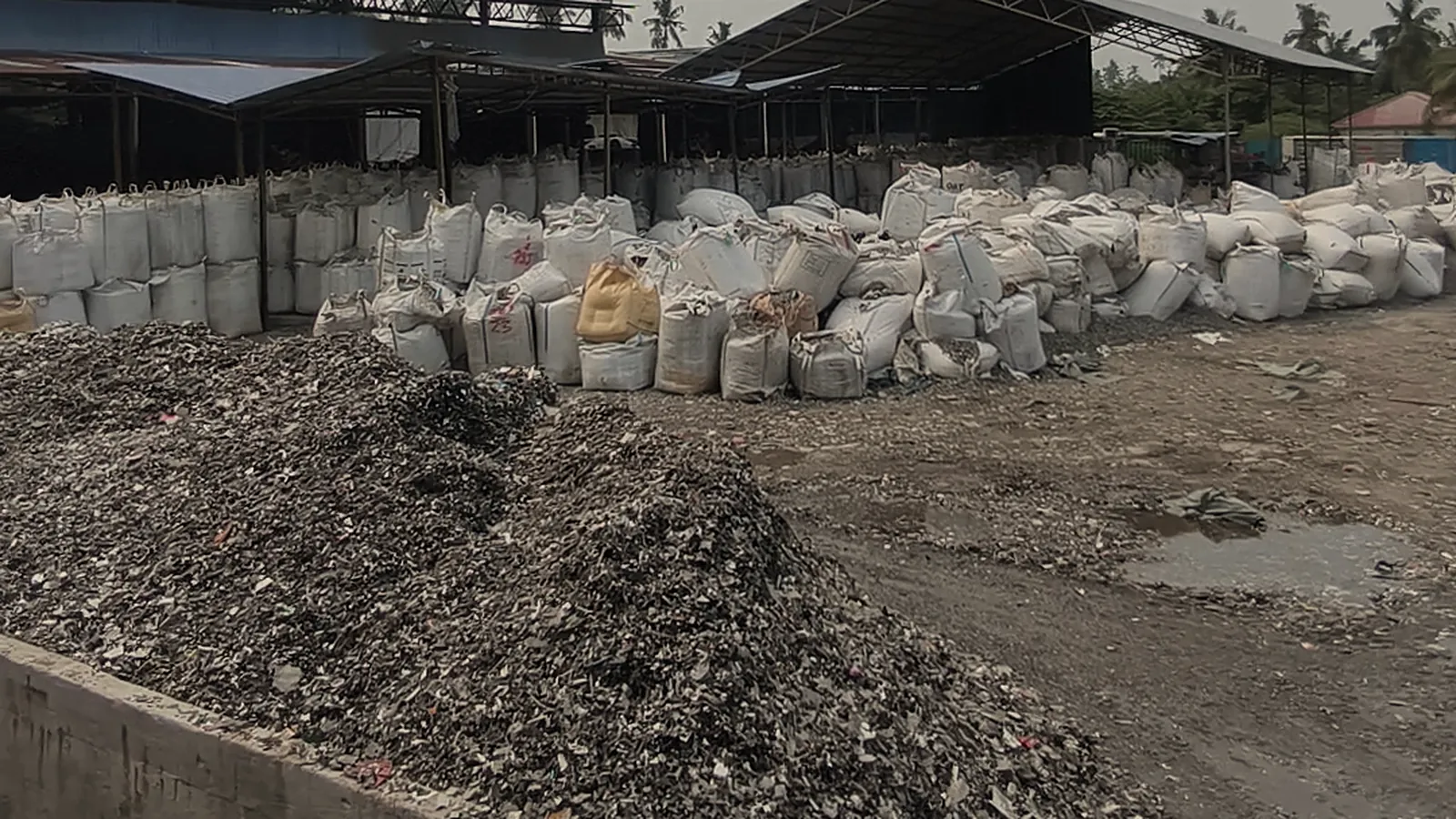
Clean, single-polymer lots matter to us for a practical reason: in Dayatas Profab's own production footage, the flakes are washed and sorted before they are extruded and cut into pellets, so what goes into the washing line decides what comes out of the bag. The picture at the top of this page is a frame of that footage, crushed scrap heaped in the yard; every step is on how our resin is made.
Sources
How this guide was prepared: we read the regulators' own pages and guidelines listed below, and the trade reports named, on 25 October 2026. It is a guide, not legal advice: confirm a route with the authorities of each country on it before anything ships.
- European Commission: plastic waste shipments: prior notification and consent for EU plastic waste exports from 21 May 2026; independent audits from 21 May 2027; the ban on exports to non-OECD countries from 21 November 2026, at least until 21 May 2029
- European Commission: waste shipments: procedures carried out electronically since May 2026; the e-waste entries A1181 and Y49 from 1 January 2025
- European Commission: draft list of countries authorised to import EU waste (news, 18 September 2026): EU plastic waste exports a year, and the main destinations in 2025
- Basel Convention: plastic waste amendments, overview: entries A3210, B3011 and Y48, effective 1 January 2021
- InforMEA: Basel decision BC-14/12, the text of the plastic waste entries: B3011 names PS and ABS; specifications as a reference for 'almost free from contamination'; storage before recycling
- US EPA: international requirements for the export and import of plastic recyclables and waste: the US is not a Basel party; its agreement with OECD members; RCRA and non-hazardous plastic scrap; prior written consent
- Ministry of the Environment, Japan: criteria for plastic wastes controlled under the Japanese Basel Act: criteria A to D for single-resin plastic waste; single-colour flakes; prior informed consent for controlled plastic
- United Nations Treaty Collection: status of the Basel Convention: Japan (1993), the Republic of Korea (1994) and Malaysia (1993) parties; the United States a signatory only
- Wikipedia: OECD, member countries: the 38 members, Japan and South Korea among them; Malaysia not a member
- SIRIM QAS: importation of waste plastic: the Certificate of Approval from 1 July 2025; control coordinated by MITI; HS 39.15; the two methods of importation
- SIRIM: Guidelines for Importation and Inspection of Waste Plastic (May 2025, edition 1 rev 1): eligible importers and countries; acceptance criteria; the two inspection methods; sampling; returns; documents
- Resource Recycling: Malaysia fully halting US plastic scrap imports (1 July 2025): US shipments not eligible for Malaysia; US scrap plastic exports to Malaysia in 2024
- Al Jazeera: why Thailand has banned imports of plastic waste (14 January 2025): Thailand's ban from 1 January 2025; China's ban in 2018; Japan's exports to Thailand in 2023
- EVS: EN 15347-1:2024, Plastics, sorted plastics wastes, Part 1: general characterisation: the properties the supplier makes known to the receiving party: required and optional data
- ANZPAC Plastics Pact: Exporting pathways, a practical guide for exporting plastic waste (version 1, May 2025): finding buyers through trading platforms and brokers; due diligence; prices; export paperwork
- International Chamber of Commerce: Incoterms rules: what the Incoterms rules set out; Incoterms 2020 in force since 1 January 2020
Two doors into Dayatas Profab A · buyers of resin B · suppliers of scrap